
Start here
The top aeo tools for ai search visibility analytics cover a messy category. Some platforms monitor whether ChatGPT, Gemini, Perplexity, or Google AI surfaces mention a brand. Others focus on citations, product-level visibility, content recommendations, or the connection between AI referrals and revenue. A few are primarily audits rather than ongoing trackers.
That distinction matters more than a small score difference. A brand team that needs daily prompt monitoring should not buy the same product as an ecommerce manager tracking SKU recommendations. Likewise, a solo SEO specialist may get more value from a free audit than from a credit-based enterprise platform.
The phrase top aeo tools for ai search visibility analytics covers all of those jobs, so we compared 10 tools rather than treating every dashboard as interchangeable. Here is the practical starting point:
Best overall match: Peec AI for daily brand mentions, rankings, citations, and sentiment across major AI models.
Best lower-cost AEO entry point: AIclicks, starting at $39 per month with GEO/AEO workflows and prompt discovery.
Best for ecommerce: AI Commerce Visibility for product, SKU, ranking, sentiment, and delivery-trust visibility.
Best broad platform coverage: MaxAEO, which monitors eight major AI platforms and competitor positions.
Best for connecting visibility to revenue: CrunchJunkie, with AI-to-conversion attribution and marketing reporting.
Best free first look: Brand Analyzer, a no-sign-up, seven-dimension brand and AEO audit.
The rest of the guide explains where each tool earns its place and where its limits become important.
Segment comparison
| Segment | Strongest fit | What it measures | Tool to inspect first |
|---|---|---|---|
| Ongoing brand monitoring | Marketing and brand teams | Mentions, rankings, citations, sentiment | Peec AI |
| GEO/AEO optimization | Web businesses and SEO teams | AI search score, audience prompts, optimization opportunities | AIclicks |
| Ecommerce visibility | Ecommerce managers | Product and SKU recommendations, category ranking, delivery trust | AI Commerce Visibility |
| Broad engine monitoring | Brand managers | Platform coverage, share of voice, competitors, citations | MaxAEO |
| Reporting and attribution | Performance marketers | Mentions, citations, sentiment, AI-driven sessions and revenue | CrunchJunkie |
The dividing line is not simply "how many AI engines are supported." Coverage is useful only when the tool gives you a repeatable workflow after a visibility change appears. Peec AI and Geneo lean toward monitoring. AIclicks and First Answer AI add optimization guidance. Meev goes further by turning findings into an action plan and content workflow. CrunchJunkie is the outlier for measurement beyond visibility itself.
Shortlist paths
| Your situation | Start with | Why |
|---|---|---|
| You need a dependable daily baseline | Peec AI | Daily refreshes plus position, citation, and sentiment tracking |
| You want to discover what customers ask AI | AIclicks | Prompt discovery and an AI Search Score audit |
| Your business sells many products | AI Commerce Visibility | Product-level and SKU visibility tracking |
| You need recommendations, not just charts | Meev | Prioritized action plan and a 16-point content quality firewall |
| You report marketing performance to clients | CrunchJunkie | Nine-engine monitoring, integrations, reports, and AI-to-conversion attribution |
A sensible evaluation sequence is to begin with the questions your team can act on. "Are we mentioned?" is a monitoring question. "Why does a competitor rank ahead of us?" calls for competitive analysis. "Did AI visibility produce qualified traffic?" requires attribution. Buying a platform before identifying that question usually leads to an impressive dashboard that nobody checks.
Ranking snapshot
| Rank | Tool | Score | Best for | Starting price |
|---|---|---|---|---|
| #1 | Peec AI | 94/100 | Marketing teams | Starter: $95/mo |
| #2 | AIclicks | 93/100 | Web businesses | Starter: $39 / month |
| #3 | AI Commerce Visibility | 93/100 | Ecommerce managers | 14-day trial; 1,000 credits |
| #4 | MaxAEO | 93/100 | Brand managers | Starter: $19/month |
| #5 | Geneo | 92/100 | Brand managers | Free: $0 |
| #6 | First Answer AI | 92/100 | Marketing managers | Start: $39/month |
| #7 | Meev | 92/100 | SEO specialists | Lite: $49/mo |
| #8 | Brand Analyzer | 90/100 | SEO specialists | Check vendor pricing |
| #9 | CrunchJunkie | 89/100 | Performance marketers | Solo: €14/mo annually |
| #10 | Aida Framework | 89/100 | Digital marketers | $99/month |
How we grouped and ranked the list
We treated AI search visibility analytics as a field guide category rather than a single-feature software class. The ranking considers five practical dimensions:
- 1
Visibility coverage: Which AI platforms and search surfaces the tool monitors, and whether it tracks mentions, recommendations, rankings, sentiment, or citations.
- 2
Actionability: Whether the product helps a team move from an observation to an optimization task, content change, or competitive response.
- 3
Audience fit: Whether the workflow suits a brand manager, ecommerce operator, SEO specialist, web business, or performance marketer.
- 4
Measurement depth: Whether the platform provides prompt history, competitor comparisons, product-level views, reporting, or conversion attribution.
- 5
Commercial friction: Free access, trial terms, starting price, plan restrictions, credit systems, retention limits, and enterprise sales requirements.
Scores are not a promise that one product will win in every account. They are a compact way to reflect category fit across the 10 candidates. In practice, a lower-ranked specialist can be the better purchase when its workflow matches your operating model.
Ranked field notes
1. Peec AI

- Marketing teams
- Free Trial
- Starts at Starter: $95/mo
- Usage signal: 260.0K
Why it matters
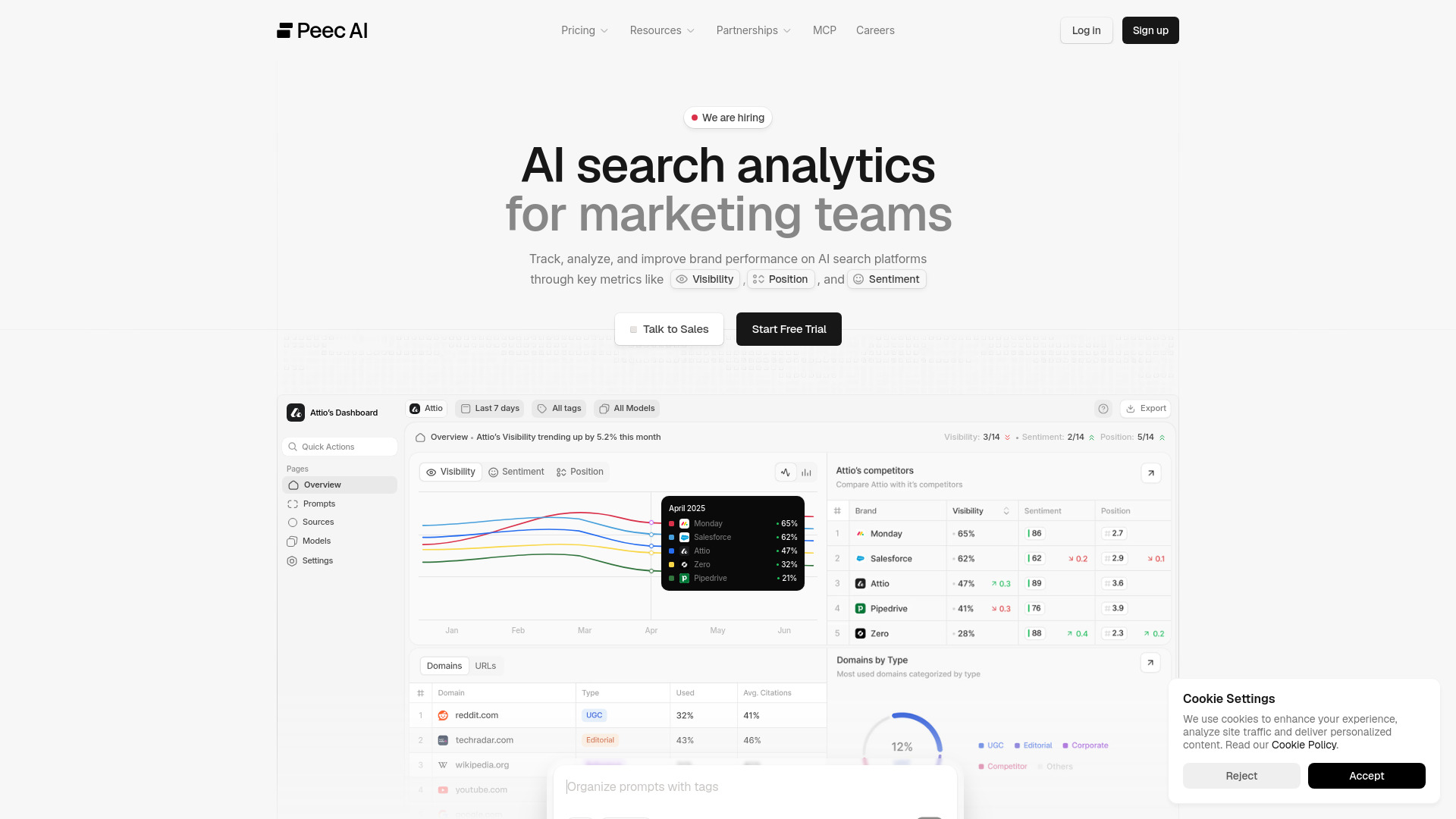
Peec AI has the clearest all-around monitoring proposition in this group. It tracks brand mentions and the less obvious source citations behind AI answers, then refreshes configured prompts daily. That combination makes it useful for teams building a baseline and watching it change over time rather than running occasional spot checks. Coverage includes ChatGPT, Perplexity, and Gemini, while position, ranking, and sentiment analysis give the dashboard more substance than a simple mention counter. The catch is that the most useful enterprise mechanics, including API access and custom setup, sit behind higher plans.
Best for
Marketing teams establishing a repeatable AI visibility reporting process
Brands that need citation and sentiment context alongside mentions
Teams monitoring ChatGPT, Perplexity, and Gemini prompts daily
Limitations
Starter and Pro tiers restrict tracking to a select number of models
API access and custom setup require Enterprise plans
The $95 monthly starting point may be more than a solo operator needs
Shortlist signal: Add Peec AI when daily monitoring, citations, and sentiment matter more than the lowest entry price.
2. AIclicks

- Web businesses
- Free audit only
- Starts at Starter: $39 / month
- Usage signal: 65.4K
Why it matters
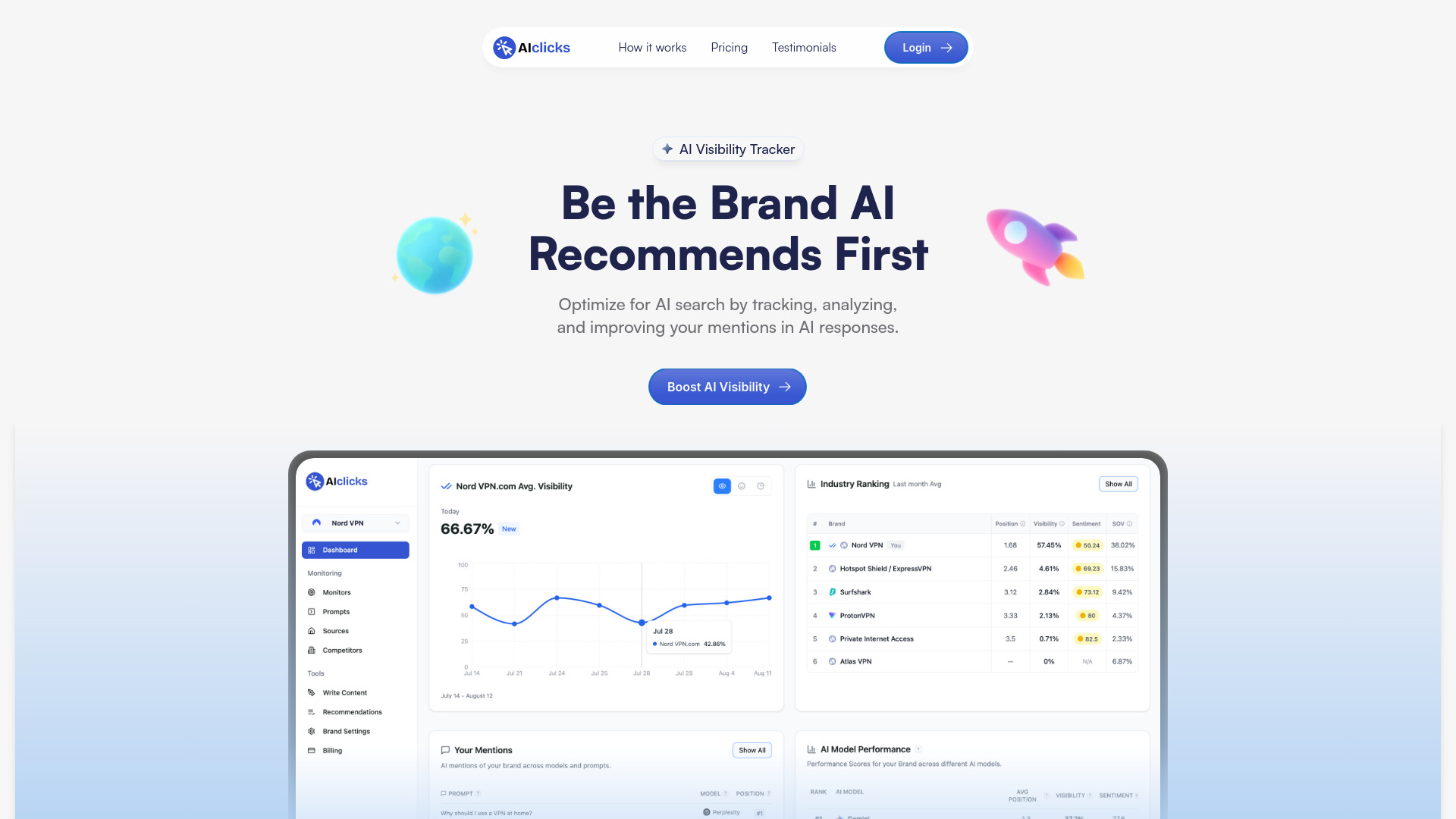
AIclicks is a strong choice when the goal is not merely to observe AI answers but to improve a brand's appearance in them. It is purpose-built around Generative Engine Optimization and Answer Engine Optimization, with an AI Search Score audit and prompt discovery for audience questions. The product supports tracking across ChatGPT, Perplexity, Gemini, Claude, Grok, DeepSeek, and Meta AI, giving web businesses a wide surface to investigate. At $39 per month for 20 tracked prompts and one website, it is easier to trial financially than several monitoring-first platforms, although there is no explicit free core tier.
Best for
Web businesses connecting audience questions to AEO work
SEO teams that want GEO/AEO framing rather than generic rank reporting
Marketers needing visibility across a broad set of AI platforms
Limitations
There is no explicit free tier or trial for the core service
The free option is an audit rather than ongoing platform access
Prompt limits can matter for businesses with multiple sites or audiences
Shortlist signal: Choose AIclicks when prompt discovery and AEO optimization are central to the project.
3. AI Commerce Visibility

- Ecommerce managers
- 14-day trial with 1,000 credits
- Starts at 14-day trial; 1,000 credits
- Usage signal: 140.1K
Why it matters
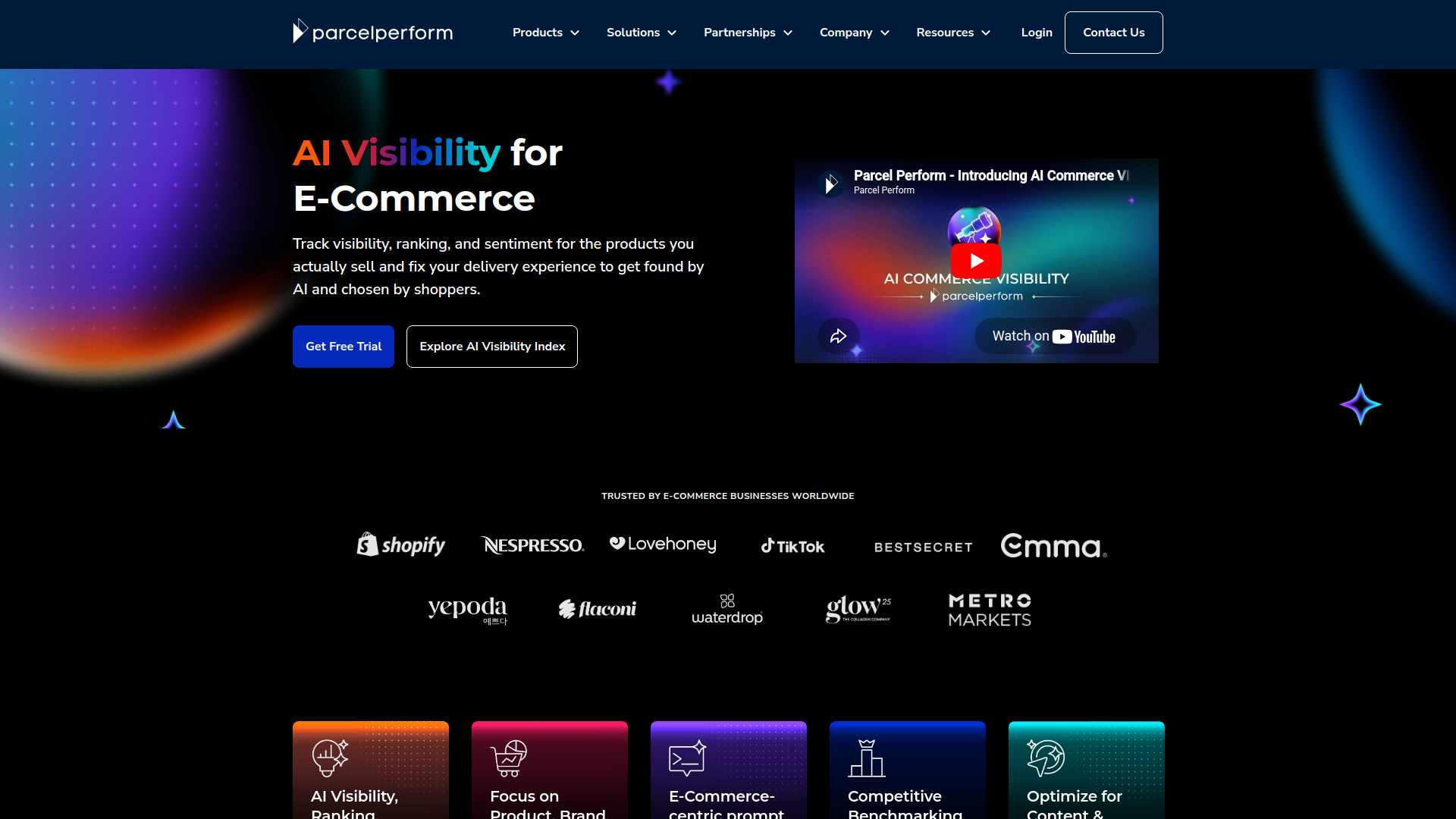
Generic brand visibility reports can miss the most important ecommerce question: does the AI recommend the right product, in the right category, with enough trust to support a purchase? AI Commerce Visibility focuses on that layer. It tracks visibility across ChatGPT, Perplexity, and Gemini, then adds product-level and SKU visibility, ranking, sentiment, and delivery-trust analysis. That operational focus is its real differentiator. Full value depends on connecting operational data, and traditional SEO teams may need time to adapt to a workflow that treats delivery experience as part of AI discoverability.
Best for
Ecommerce managers tracking products and SKUs rather than only corporate mentions
Retail teams investigating category ranking and recommendation context
Businesses where delivery trust affects AI-generated buying advice
Limitations
Full benefit requires operational data connectivity
Traditional SEO professionals may face a learning curve
The usage-based model requires attention to credit consumption
Shortlist signal: Put this on the shortlist when AI recommendations must be evaluated at product and delivery-experience level.
4. MaxAEO

- Brand managers
- Free report
- Starts at Starter: $19/month
- Usage signal: 9.7K
Why it matters
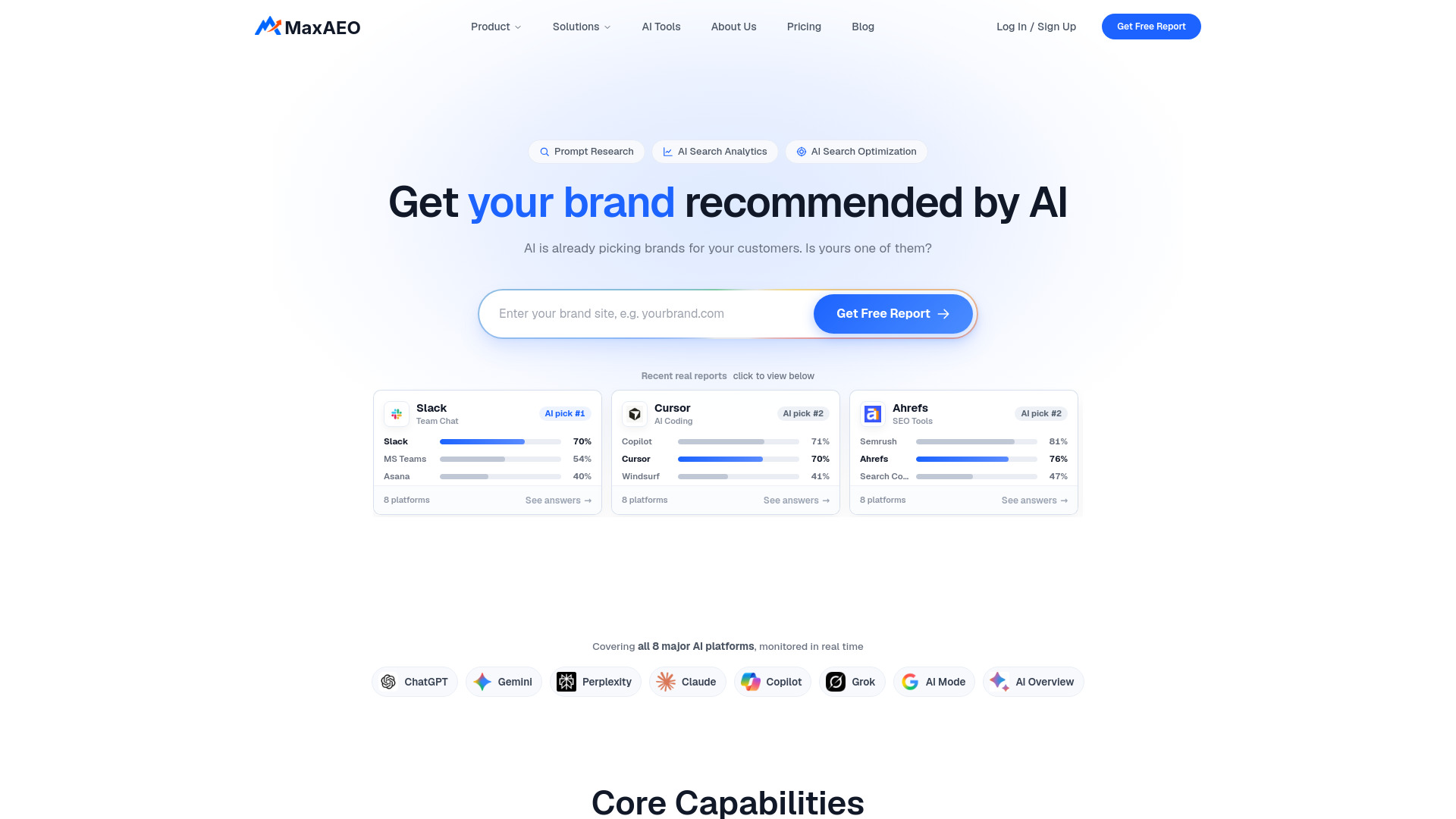
MaxAEO packs an unusually broad list of surfaces into a straightforward visibility-monitoring pitch: ChatGPT, Gemini, Perplexity, Claude, Copilot, Grok, Google AI Overview, and Google AI Mode. Its dashboard covers mention rate, recommendation position, sentiment, competitor ranking, and AI citations, so brand managers can compare performance by query and platform. The $19 monthly starter plan is approachable, but its limits are meaningful: four platforms, 10 search prompts, five competitors per brand, and 30-day retention. This is a good low-cost way to establish coverage, not necessarily the final home for a large historical dataset.
Best for
Brand managers who want many AI surfaces in one monitoring view
Smaller teams comparing their brand with named competitors
Buyers who prefer a low starting price and no technical setup
Limitations
The lowest paid tier retains data for only 30 days
Lower tiers restrict platform access and tracked prompts
Broad coverage becomes less useful if your plan cannot include the surfaces you need
Shortlist signal: Choose MaxAEO when broad platform coverage and an accessible starter plan outweigh deep historical retention.
5. Geneo

- Brand managers
- 50 credits and 3-day free trial
- Starts at Free: $0
- Usage signal: 11.4K
Why it matters
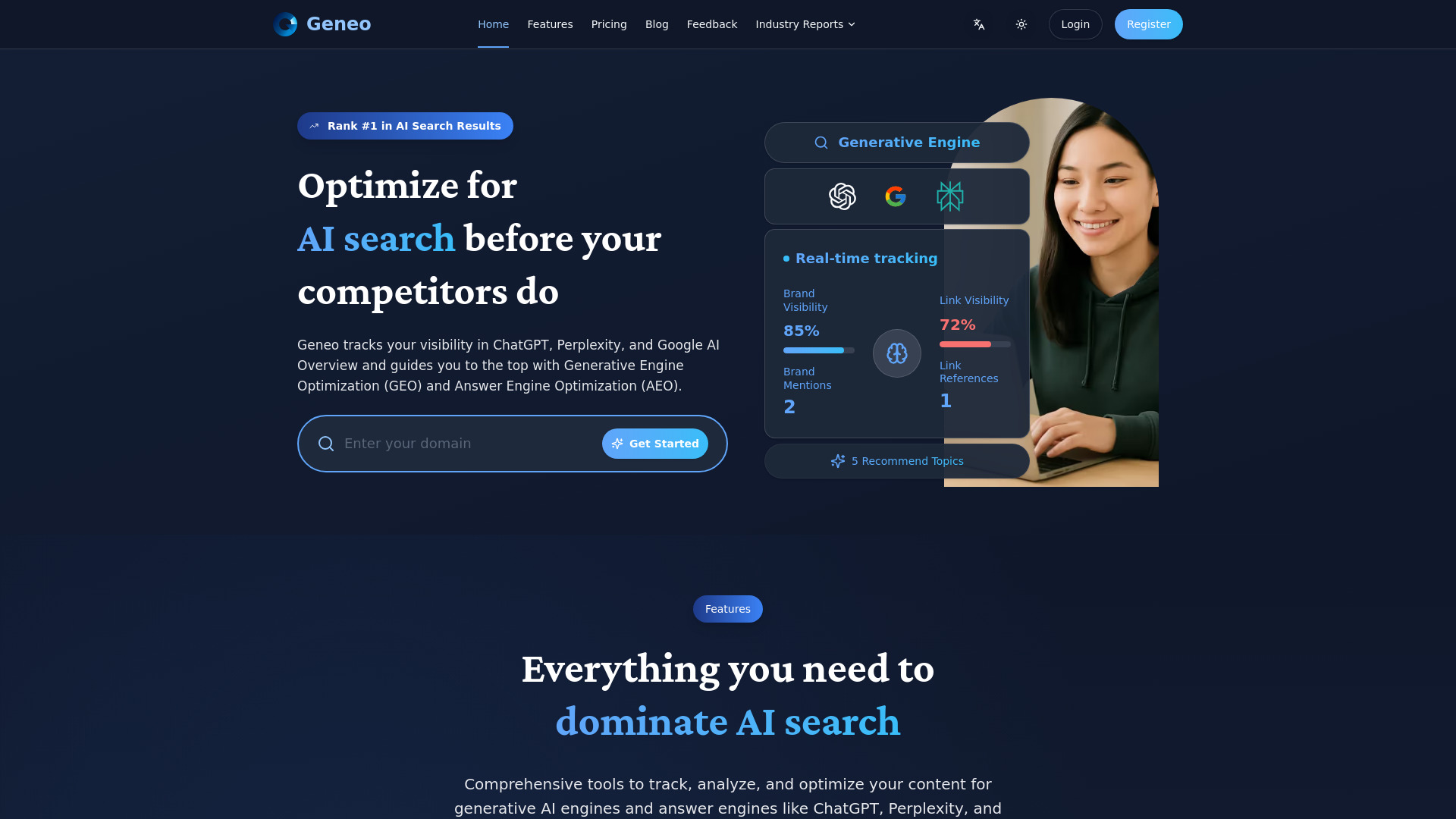
Geneo takes a focused approach to brand presence across ChatGPT, Google AI Overview, and Perplexity. Its prompt history tracking helps teams revisit AI search interactions instead of relying on a single current snapshot, while AI-powered sentiment analysis adds context to each mention. That makes it a sensible middle ground for brand managers who want ongoing monitoring without immediately committing to a very broad engine list. The credit-based system deserves attention before scaling: high-volume tracking can require careful management, and enterprise pricing requires direct contact.
Best for
Brand managers tracking a focused set of major AI platforms
Teams that need prompt history and sentiment in the same workflow
Buyers who want to begin with 50 credits and a short trial
Limitations
Credits may require careful management at higher usage volumes
Enterprise pricing is not immediately transparent
Platform coverage is narrower than the broadest tools in this list
Shortlist signal: Consider Geneo when prompt history and sentiment are more important than monitoring every available AI engine.
6. First Answer AI

- Marketing managers
- Free analysis; no credit card required
- Starts at Start: $39/month
- Usage signal: 3.3K
Why it matters
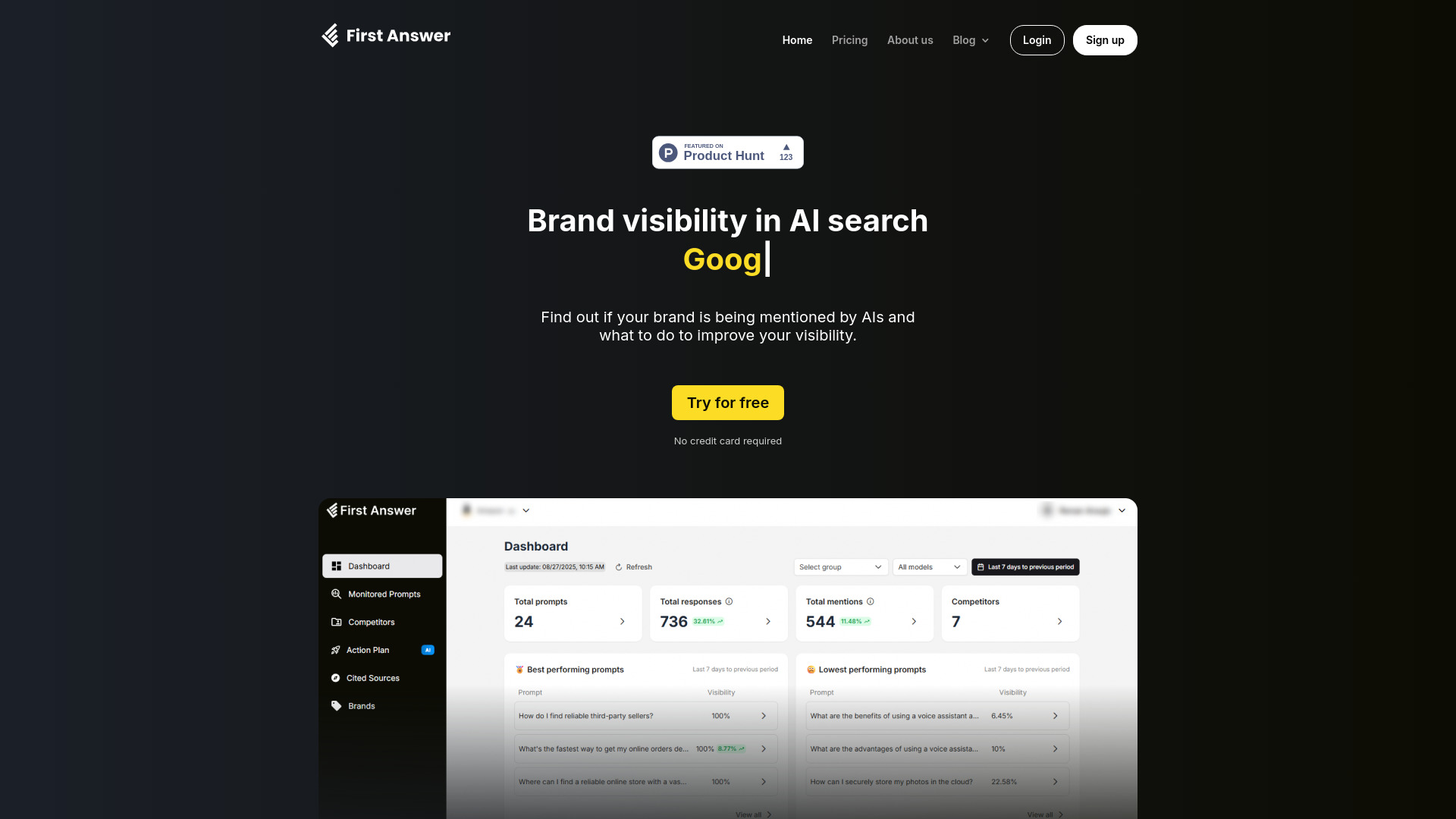
First Answer AI is built for marketing managers who need to explain how their brand performs across leading LLMs and what to do next. It monitors ChatGPT, Google AI Overviews, Gemini, Copilot, Grok, and Perplexity, then layers in competitive analysis and actionable GEO recommendations. The free analysis is a useful low-friction starting point, but the quality of the output depends on the prompts a team chooses and refines. Lower plans also limit monitored prompts and competitors, so larger programs should test scale before treating the $39 starting price as the complete budget.
Best for
Marketing managers comparing brand mentions with competitors
Teams working across GEO, AIO, and Answer Engine Optimization
Buyers who want a free analysis before paying for ongoing tracking
Limitations
Lower tiers limit monitored prompts and competitors
Users must define and refine prompts for useful monitoring
A free analysis is not the same as a permanent free tracking plan
Shortlist signal: Add First Answer AI when competitive context and optimization recommendations need to sit beside visibility data.
7. Meev

- SEO specialists
- 7-day free trial
- Starts at Lite: $49/mo
- Usage signal: 3.5K
Why it matters
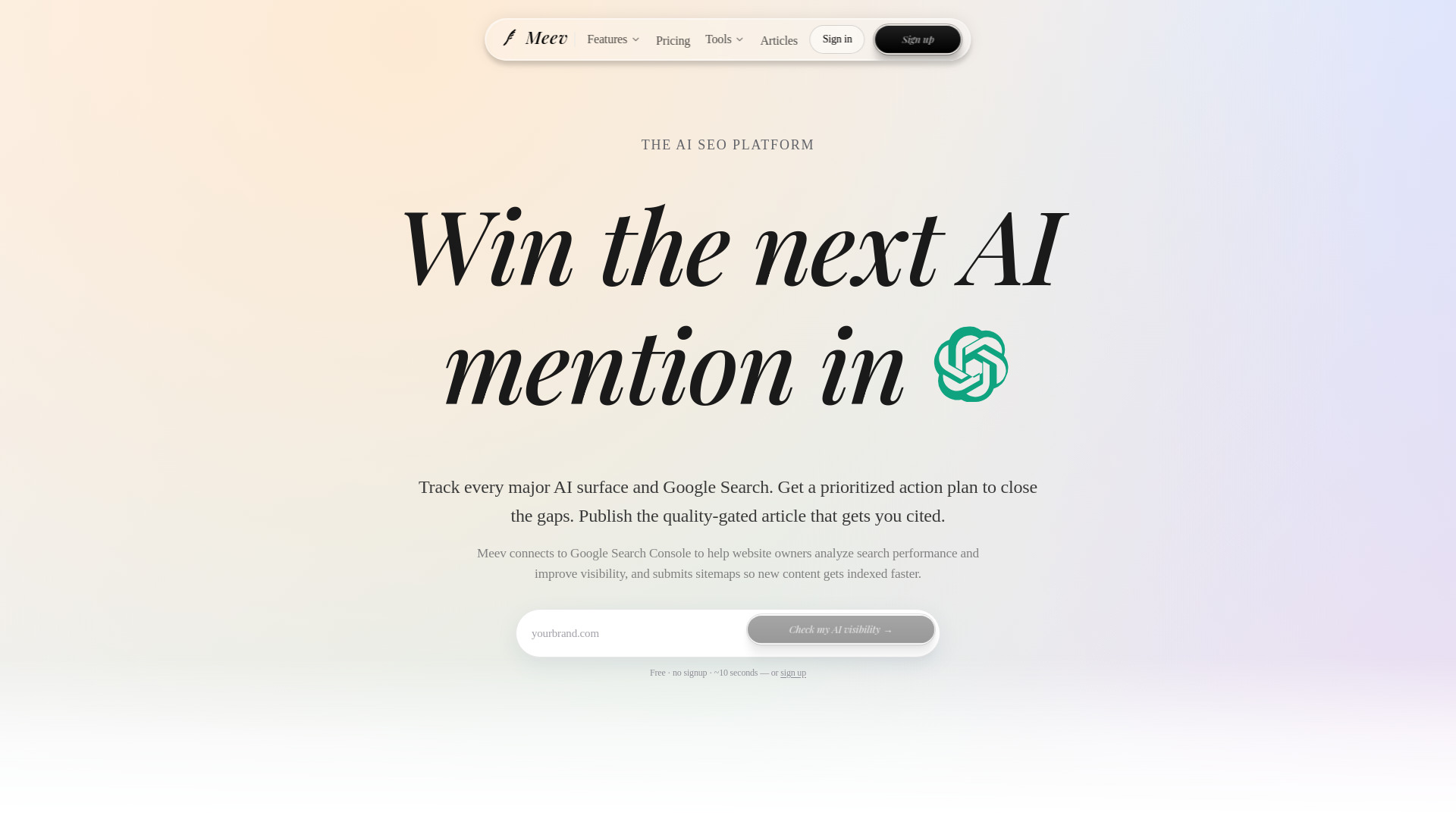
Meev stands out because it tries to close the gap between visibility reporting and execution. Alongside tracking across ChatGPT, Claude, Gemini, Perplexity, Grok, DeepSeek, and Google AI Overviews, it creates a prioritized AI action plan based on impact-to-effort analysis. Its quality firewall checks content depth, accuracy, and helpful-content risk across a 16-point gate. That is appealing for SEO specialists who want a workflow after the report, not another chart to interpret. The tradeoff is tiered engine access: Claude and Grok require Pro or Agency plans, and the trial enforces daily article-generation caps.
Best for
SEO specialists turning AI visibility findings into content tasks
Teams that value impact-to-effort prioritization
Organizations monitoring a broad range of LLM and AI search surfaces
Limitations
Premium engines such as Claude and Grok require higher tiers
Trial users face daily article-generation caps
Content workflow features may be unnecessary for monitoring-only teams
Shortlist signal: Choose Meev when your team needs prioritized actions and quality checks after measuring visibility.
8. Brand Analyzer

- SEO specialists
- Free; no sign-up required
- Starts at Check vendor pricing
- Usage signal: Not listed
Why it matters
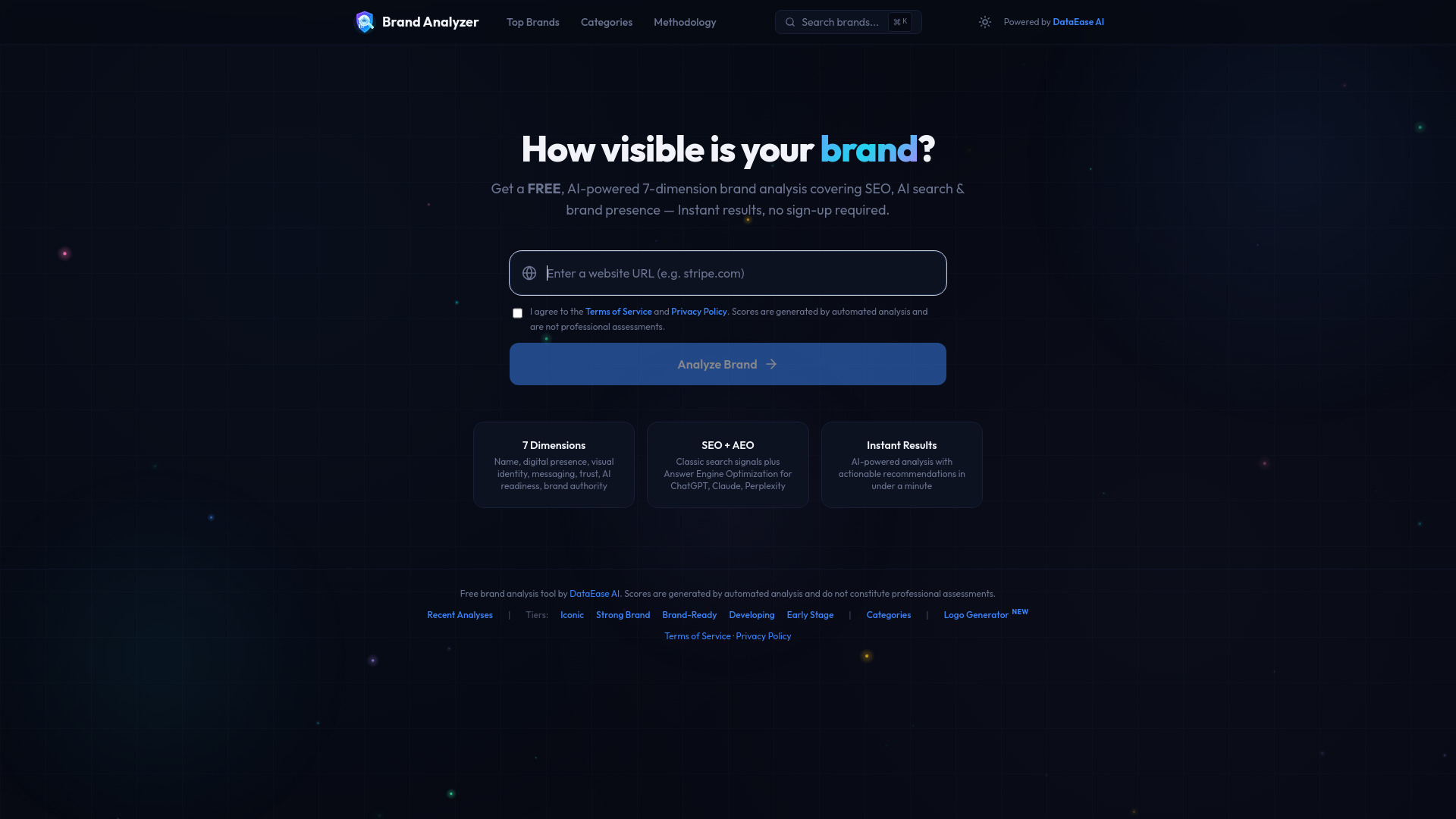
Brand Analyzer is the quickest way to get a baseline without creating an account or opening a procurement conversation. Its seven-dimension analysis covers brand name, digital presence, visual identity, messaging, trust, AI readiness, and brand consistency. It also provides SEO and AEO insights for classic search and AI surfaces including ChatGPT, Claude, Perplexity, and Google. Results arrive in under a minute, making it useful for an initial diagnosis or a workshop exercise. It is an automated audit, though, not a detailed reporting history or a substitute for repeat monitoring.
Best for
SEO specialists needing a fast first-pass brand and AEO audit
Small teams that do not want to create an account
Workshops that need actionable baseline recommendations quickly
Limitations
Automated scores are not professional assessments
There is no detailed custom reporting history without manual tracking
Pricing details are hidden behind vendor-level clarification
Shortlist signal: Start with Brand Analyzer when you need a free baseline before deciding whether ongoing monitoring is justified.
9. CrunchJunkie
- Performance marketers
- 14-day free trial
- Starts at Solo: EUR14/mo billed annually
- Usage signal: Not listed
Why it matters
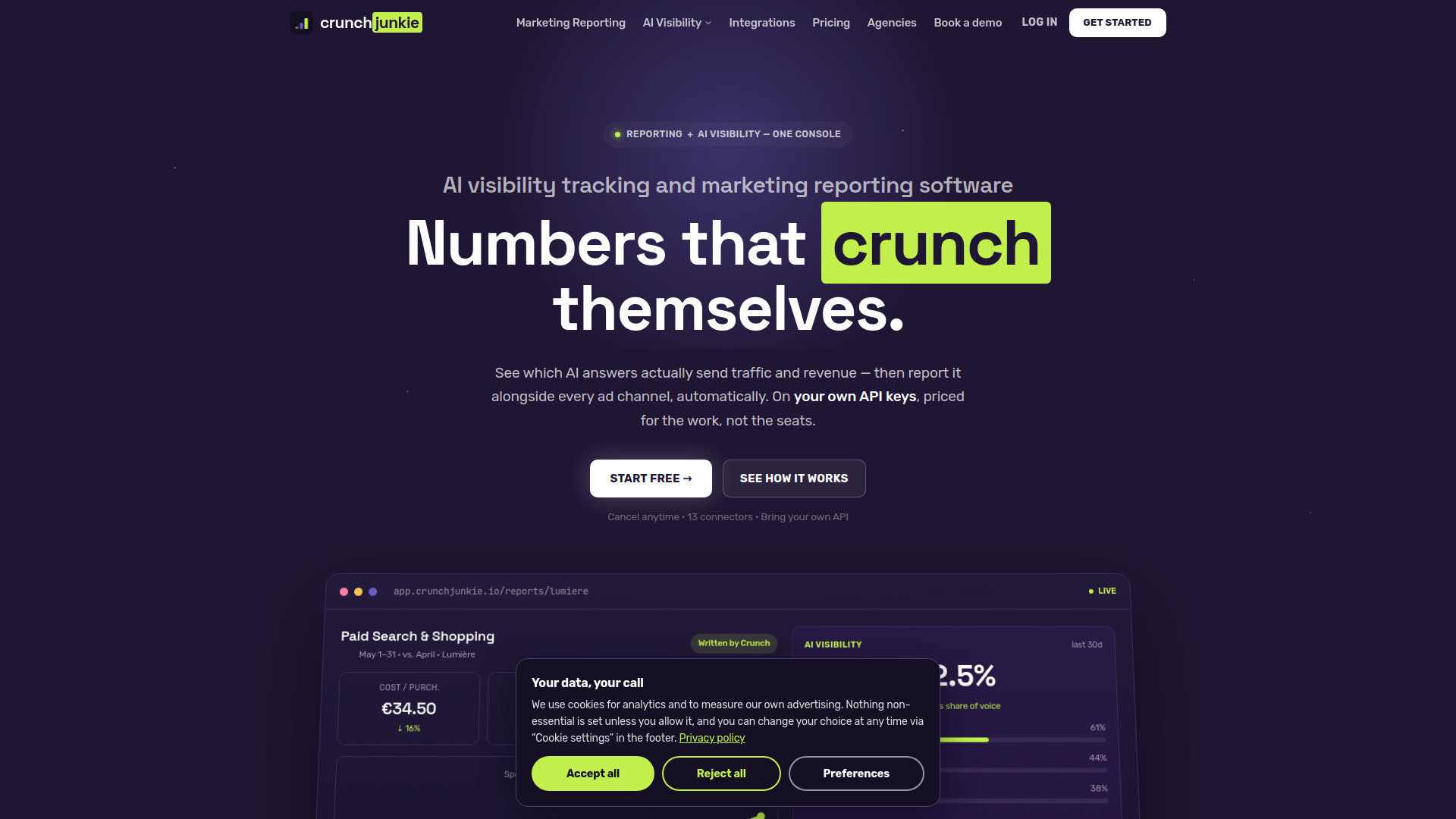
CrunchJunkie is the most measurement-oriented option here. It combines marketing reporting with AI visibility tracking across nine engines, including ChatGPT, Gemini, Perplexity, Claude, Google AI Overviews, Google AI Mode, and Copilot. Every mentions, citations, share-of-voice, and sentiment metric is shown with its sample size, which is a useful guard against overinterpreting tiny prompt sets. More importantly, AI-to-conversions attribution connects visibility with GA4 sessions, conversions, and revenue. There is no permanent free plan, and the Solo plan is single-user with CrunchJunkie branding, so agencies and teams should inspect plan fit early.
Best for
Performance marketers tying AI visibility to GA4 outcomes
Agencies that need reporting and data connections in one platform
Teams that want sample sizes shown beside visibility metrics
Limitations
There is no permanent free plan, only a 14-day trial
Solo is single-user and carries CrunchJunkie branding
Attribution is most useful when analytics and conversion data are connected correctly
Shortlist signal: Put CrunchJunkie first for evaluation when the business case depends on AI-driven sessions, conversions, or revenue.
10. Aida Framework

- Digital marketers
- AEO and GEO optimization
- Starts at $99/month
- Usage signal: Not listed
Why it matters
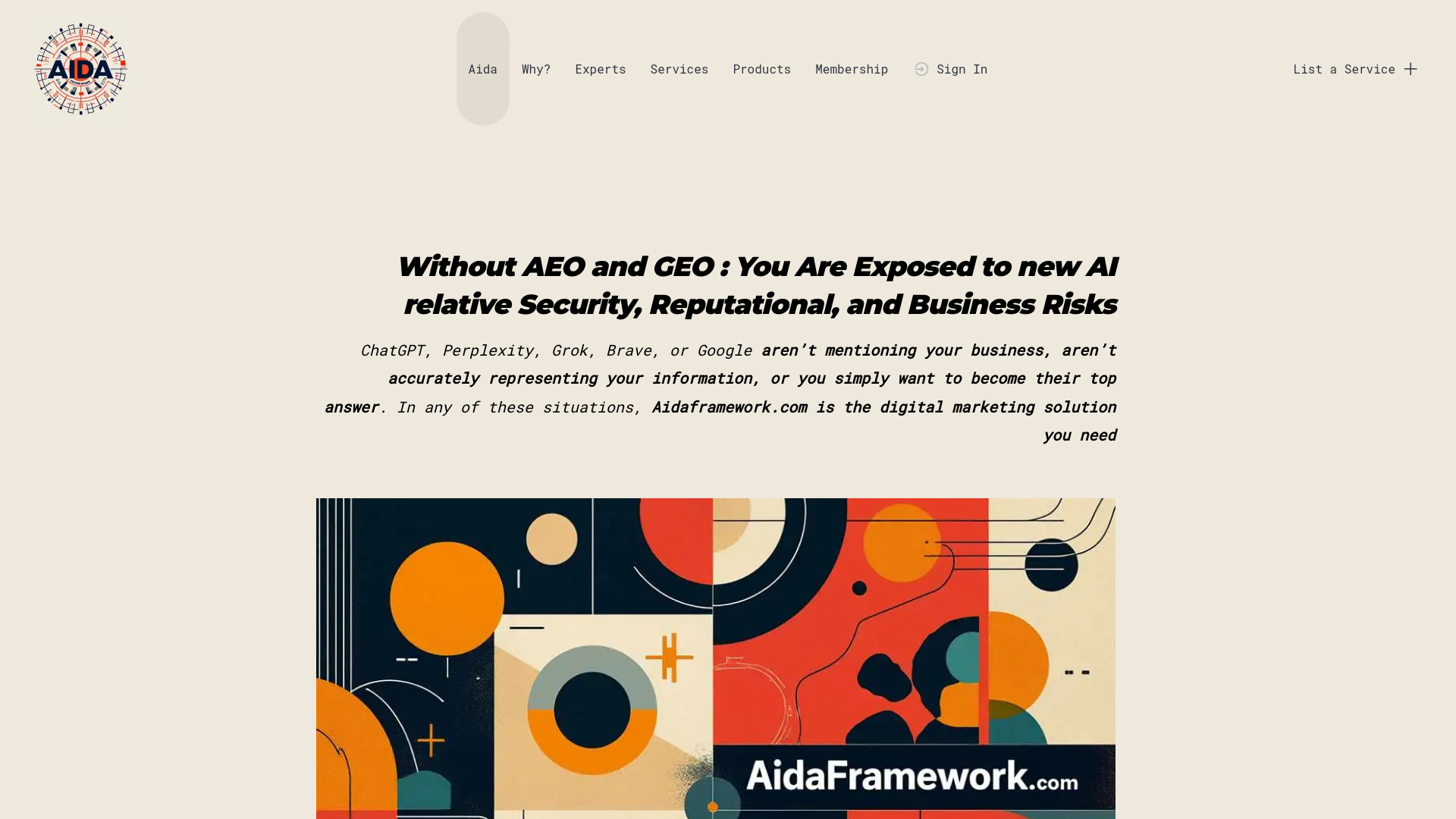
Aida Framework approaches AI visibility through AEO and GEO strategy rather than a dense monitoring dashboard. Its focus on future-proof answer-engine and generative-engine practices, plus multilingual content indexing, makes it relevant to digital marketers working across markets or building a broader content-distribution plan. It also promotes a zero-commission model for digital product sales. This is a more services- and strategy-shaped option than the monitoring specialists above, and premium mentorship adds fees. Buyers should clarify exactly which ongoing analytics, optimization, and advisory services are included at the $99 monthly level.
Best for
Digital marketers developing AEO and GEO strategy across languages
Digital product businesses concerned about sales commissions
Teams that want a strategic framework alongside AI-platform visibility work
Limitations
Premium mentorship and services carry additional fees
The product is less clearly positioned as a deep monitoring dashboard
Buyers should clarify service scope and any commission terms before purchase
Shortlist signal: Consider Aida Framework when multilingual AEO/GEO strategy and commercial guidance matter more than granular prompt reporting.
What to test before choosing
Run the same controlled evaluation across every serious candidate. A polished scorecard is less useful than seeing how a tool behaves with your actual brand, prompts, competitors, and reporting cadence.
- 1
Use a fixed prompt set. Include branded questions, category questions, comparison queries, and purchase-intent prompts. Record which prompts are supported and how many you can track on the entry plan.
- 2
Check engine coverage by plan. "Supports eight platforms" is not enough if your plan includes only four. Confirm whether the relevant ChatGPT, Gemini, Perplexity, Google AI, Claude, Copilot, or other surfaces are available to your account.
- 3
Inspect citations, not just mentions. Ask whether the platform identifies source citations behind an answer and whether you can export or revisit them.
- 4
Test competitor comparisons. Look for recommendation position, share of voice, sentiment, and competitor ranking. A single mention count cannot explain why another brand is preferred.
- 5
Measure refresh behavior. Daily tracking, real-time updates, and prompt history are different operating models. Test how quickly a known change appears in the dashboard.
- 6
Try the handoff to action. For optimization-led products, inspect whether recommendations are specific enough to assign to a writer, SEO specialist, or product team.
- 7
Validate attribution requirements. If revenue matters, confirm what integrations and analytics connections are needed. CrunchJunkie's approach is notably more explicit here than most visibility-only tools.
- 8
Calculate usage limits. Credits, tracked prompts, competitors, retention windows, and article-generation caps can change the economics faster than the headline subscription price.
What to do next
Start with a two-tool pilot instead of signing an annual contract immediately. Pair one monitoring-first product, such as Peec AI, Geneo, or MaxAEO, with one workflow-oriented or attribution-oriented product, such as Meev, AIclicks, or CrunchJunkie. Run the same prompts for several reporting cycles and ask three questions:
Can the team explain a visibility change without guessing?
Can someone turn the finding into a concrete content, product, or technical task?
Can the organization connect the work to a meaningful outcome, such as qualified traffic, conversions, or revenue?
For ecommerce, substitute AI Commerce Visibility into that pilot. For a low-risk baseline, use Brand Analyzer first and reserve paid evaluation for tools that can monitor the questions your team actually owns. Keep the prompt set documented; otherwise, changes in queries will look like changes in performance.
Common mistakes when choosing from a complex top list
Treating every AI mention as a win
A brand can be mentioned negatively, buried below competitors, or cited from an unhelpful source. Sentiment, position, ranking, and citation context matter.
Comparing engine counts without comparing plan limits
A platform may advertise extensive model coverage while the starter tier restricts platform access, prompts, or competitors. Always compare the usable plan, not the product's maximum capability.
Buying a dashboard without an owner
Visibility data needs a regular operator. Decide whether the owner is SEO, content, brand, ecommerce, or performance marketing, then choose a workflow that produces work that person can complete.
Ignoring sampling and prompt design
AI answers vary. A tiny or poorly chosen prompt set can create false confidence. Tools that show prompt history or sample size make interpretation easier, but the team still needs disciplined query design.
Confusing a free audit with free analytics
Brand Analyzer offers a useful free audit, while several other tools offer trials, free reports, or limited credits. None of those automatically means unlimited historical monitoring.
Treating visibility as revenue
A higher mention rate does not prove business impact. If revenue is the goal, connect AI visibility to analytics and conversion data where possible, and define the attribution model before celebrating a chart.
FAQ
AEO tools help teams understand and improve how brands, products, and content appear in answer engines and AI-generated search responses. Depending on the platform, they may track mentions, rankings, citations, sentiment, competitors, prompts, or optimization recommendations.