
Finding the right top ai search optimization tools for content creators takes more than looking for a dashboard with an "AI score." The useful question is what happens after the score: can the tool validate claims, improve copy, create supporting visuals, or turn a content idea into something your audience can actually discover? I compared 10 tools across those workflows. The result is a deliberately broad field guide: Searchify and ContentIQ are the closest fits for AI-search work, while several adjacent platforms earn their place by helping creators produce, localize, and distribute the material that search systems evaluate.
Start here
Use this quick shortlist before reading the full field notes:
| Your priority | Start with | Why it belongs on the shortlist |
|---|---|---|
| Measure and improve AI-search visibility | Searchify | Provides an AI Search Score and actionable recommendations without requiring sign-up for analysis. |
| Write better-sourced, brand-consistent articles | ContentIQ | Checks claims against live sources and adds linked citations before drafting. |
| Move from idea to social-ready creative | AI Inspo | Combines templates, multiple AI models, and one-click creative generation. |
| Optimize app-store content without Figma | AppLaunchFlow | Produces screenshots, ASO copy, and localization for mobile and tablet listings. |
| Create a repeatable virtual creator | ai influencer generator | Maintains a reusable character identity across images and short videos. |
The key distinction is simple: a visibility tool helps you understand how AI systems may surface your content, while a production tool helps you make more of the content in the first place. You may need one from each group rather than expecting a single platform to do everything.
Segment comparison
| Segment | Strongest match | Core workflow | Main trade-off |
|---|---|---|---|
| AI-search analysis | Searchify | Score visibility and follow recommendations | Confirm current pricing and workflow limits before subscribing |
| Evidence-led content | ContentIQ | Validate claims, then draft with citations | Continued use requires a paid plan after the first article |
| Creator production | AI Inspo | Generate images and video from templates and models | Free output is watermarked and tightly limited |
| App-store growth | AppLaunchFlow | Build screenshots, ASO copy, and translations | Free exports are preview-only |
| Paid distribution | Muze AI | Create, run, and optimize Meta and Google ads | Power plan supports up to $10,000 in monthly ad spend |
This is an unusual category because "search optimization" can mean several different things. Searchify addresses AI-response visibility directly. ContentIQ tackles the trust and sourcing layer that makes content more useful to both readers and answer engines. The remaining tools are broader visual studios, app-growth systems, and distribution tools that matter when the bottleneck is not strategy but producing enough high-quality material to publish.
Shortlist paths
| If you are... | Consider this path | What to verify first |
|---|---|---|
| A solo writer building authority | ContentIQ -> Searchify | Whether the source checks and visibility recommendations fit your publishing cadence |
| A social-first creator | AI Inspo -> Inspix AI | Credit consumption, watermark rules, and the formats you publish most often |
| An indie app developer | AppLaunchFlow | Screenshot export limits, illustration allowances, and supported languages |
| A Shopify brand | Muze AI -> Didoo AI | Ad-platform coverage, budget controls, and how much strategy you retain |
| A virtual-influencer operator | ai influencer generator | Character consistency, credit burn, and short-video requirements |
These paths are more useful than a generic "best tool" answer. A writer who needs citations should not choose an ad optimizer simply because it has a polished AI interface; likewise, a brand producing daily creative may value fast multi-model generation more than a sophisticated visibility score.
Ranking snapshot
| Rank | Tool | Best for | Score | Starting price |
|---|---|---|---|---|
| #1 | AI Inspo | Content creators | 92/100 | Check vendor pricing |
| #2 | AppLaunchFlow | Indie developers | 92/100 | Free: EUR0 /mo |
| #3 | Muze AI | Shopify Brands | 92/100 | Free: $0 for 7 days |
| #4 | Didoo AI | Small and Medium Businesses | 92/100 | Starter (Monthly): $69/month |
| #5 | Searchify | SEO professionals | 91/100 | Check vendor pricing |
| #6 | ContentIQ | Founders | 88/100 | Single brand: $39/month |
| #7 | BukiTools | Content Writers | 88/100 | Free: $0 |
| #8 | ai influencer generator | Solo creators | 88/100 | $15.83/month billed annually |
| #9 | Inspix AI | Content creators | 88/100 | Basic: $19/month |
| #10 | seedeo | Content creators | 88/100 | Check vendor pricing |
Scores are directional rather than a promise of search performance. The first four tools lead on the supplied category fit and practical creator workflows, while Searchify and ContentIQ are the most directly relevant choices for AI-search research and content quality.
How we grouped and ranked the list
I grouped the tools by the job they help a creator complete: visibility analysis, evidence-led writing, app-store optimization, paid distribution, or visual production. That prevents a narrow tool from being penalized simply because it does not generate video, and it keeps a broad creative suite from being mistaken for a dedicated AI-search monitor.
The ranking weighs four things. First, direct relevance to content discovery or content production. Second, whether the feature set supports a repeatable workflow instead of a one-off demo. Third, audience fit: an indie developer and a Shopify brand have very different definitions of useful automation. Finally, I considered practical friction, including credit systems, watermarks, platform restrictions, setup requirements, and pricing clarity.
One important caveat: several products here are adjacent alternatives rather than pure AI search optimization platforms. That is intentional. Content creators often need to research, write, package, localize, publish, and promote content as one connected process. A shortlist that only measures visibility can miss the production bottleneck that prevents a creator from acting on the recommendations.
Ranked field notes
1. AI Inspo

- Content creators
- 100 credits weekly; all-in-one workflow; multi-model video support
- Starts at Check vendor pricing
- Usage signal: 26.2K

Why it matters
AI Inspo earns the first position because it addresses the messy middle between a content idea and a ready-to-share asset. Instead of forcing creators to jump between separate image, video, and ideation products, it brings ready-to-use templates and multiple current AI models into one workflow. The integration with models such as Sora, Veo, and Kling is particularly useful for creators who want to compare visual approaches without rebuilding a prompt and project in three different interfaces. It is not a dedicated AI-search measurement suite, but it can make it much easier to produce the supporting creative that gives a content campaign enough range to test.
Best for
Creators who need both image and video generation in one place
Social teams turning trends and ideas into repeatable creative
Users who want template-led generation rather than a blank prompt box
Limitations
The free plan allows only three videos and three images weekly
Free-tier outputs contain watermarks
Vendor pricing should be checked before purchase because the card's plan information is not a clean price quote
Shortlist signal: Add AI Inspo when your biggest constraint is producing varied, publishable creative around a content topic.
2. AppLaunchFlow

- Indie developers
- Free 1 project; preview-only export; ASO copy and translations
- Starts at Free: EUR0 /mo
- Usage signal: 31.7K
Why it matters
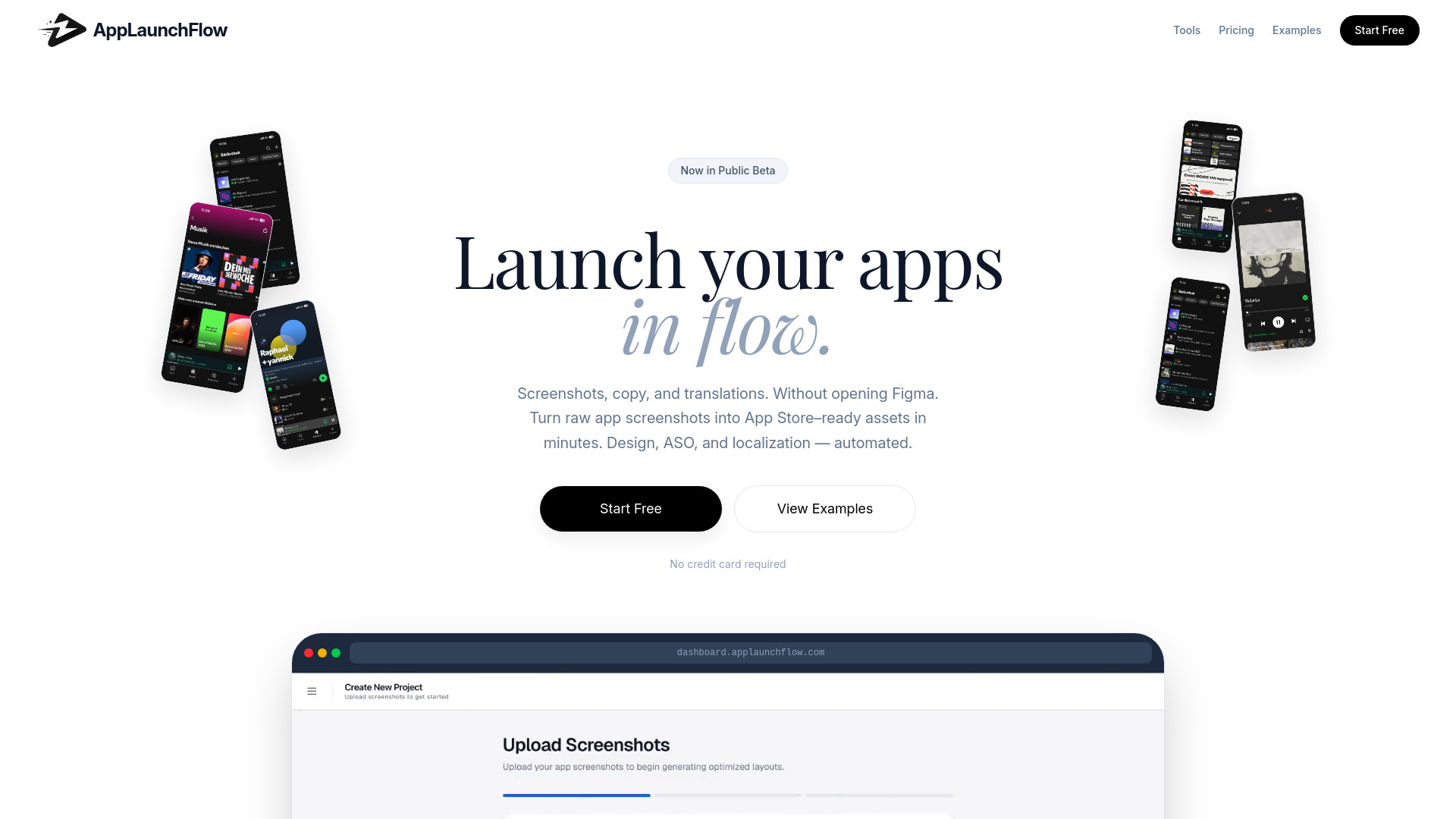
For app creators, discoverability often depends on more than web content. AppLaunchFlow focuses on the storefront where screenshots, descriptions, and localization directly shape conversion. It can create store-ready mobile and tablet screenshots, generate and optimize ASO copy, and localize listings into more than 20 major languages. The no-Figma workflow is the real draw: an indie developer can move from product information to a presentable listing without adding a separate design handoff. That makes it an unexpected but practical alternative for creators whose "search optimization" problem lives in an app store.
Best for
Indie developers preparing their first App Store or Google Play listing
Small teams without a dedicated product designer
Launches that need localized copy and screenshots quickly
Limitations
The free plan limits screenshot export to preview mode
Starter limits apply to illustrations and languages
It is centered on app-store assets, not general web content or AI-answer tracking
Shortlist signal: Choose AppLaunchFlow when app-store copy, screenshots, and localization are the discovery levers you need to improve.
3. Muze AI

- Shopify Brands
- 7-day free trial; autonomous optimization; image and video ads
- Starts at Free: $0 for 7 days
- Usage signal: 10.5K
Why it matters
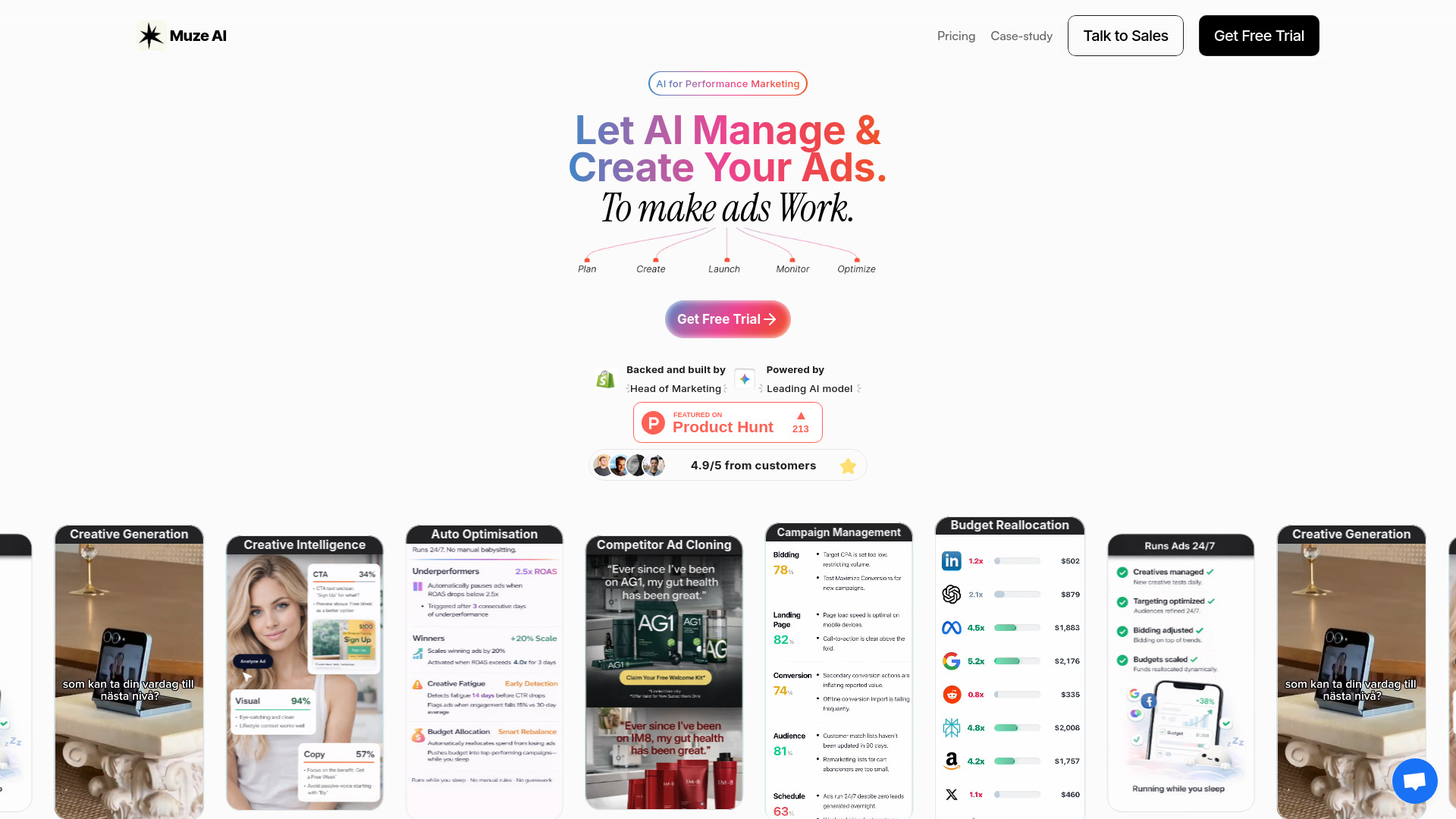
Muze AI takes a content idea all the way into performance marketing. It creates image and video ads, manages campaigns on Meta and Google, and handles ongoing optimization and budget reallocation. The promise is operational rather than editorial: generate 10 ad variations in 90 seconds and let the system work continuously. For a Shopify brand, that can connect content production to measurable distribution instead of leaving a library of unused creative on a drive. The trade-off is equally clear: you are delegating a meaningful part of performance marketing strategy and execution to the platform.
Best for
Shopify brands that need a steady stream of ad variations
Lean marketing teams managing paid social and search
Operators comfortable with automated optimization and budget movement
Limitations
The Power plan starts at $399/month, so it is not a casual creator purchase
The lower-tier Power plan supports up to $10,000/month in ad spend
Relying on the platform for end-to-end execution may not suit teams that want granular control
Shortlist signal: Put Muze AI on your list when paid distribution, not content drafting, is the main growth bottleneck.
4. Didoo AI - URL in, Meta ads out. One Click to Outperform.

- Small and Medium Businesses (SMBs)
- Free 7-day trial; Meta ad creation, launch, and optimization
- Starts at Starter (Monthly): $69/month
- Usage signal: 11.9K
Why it matters
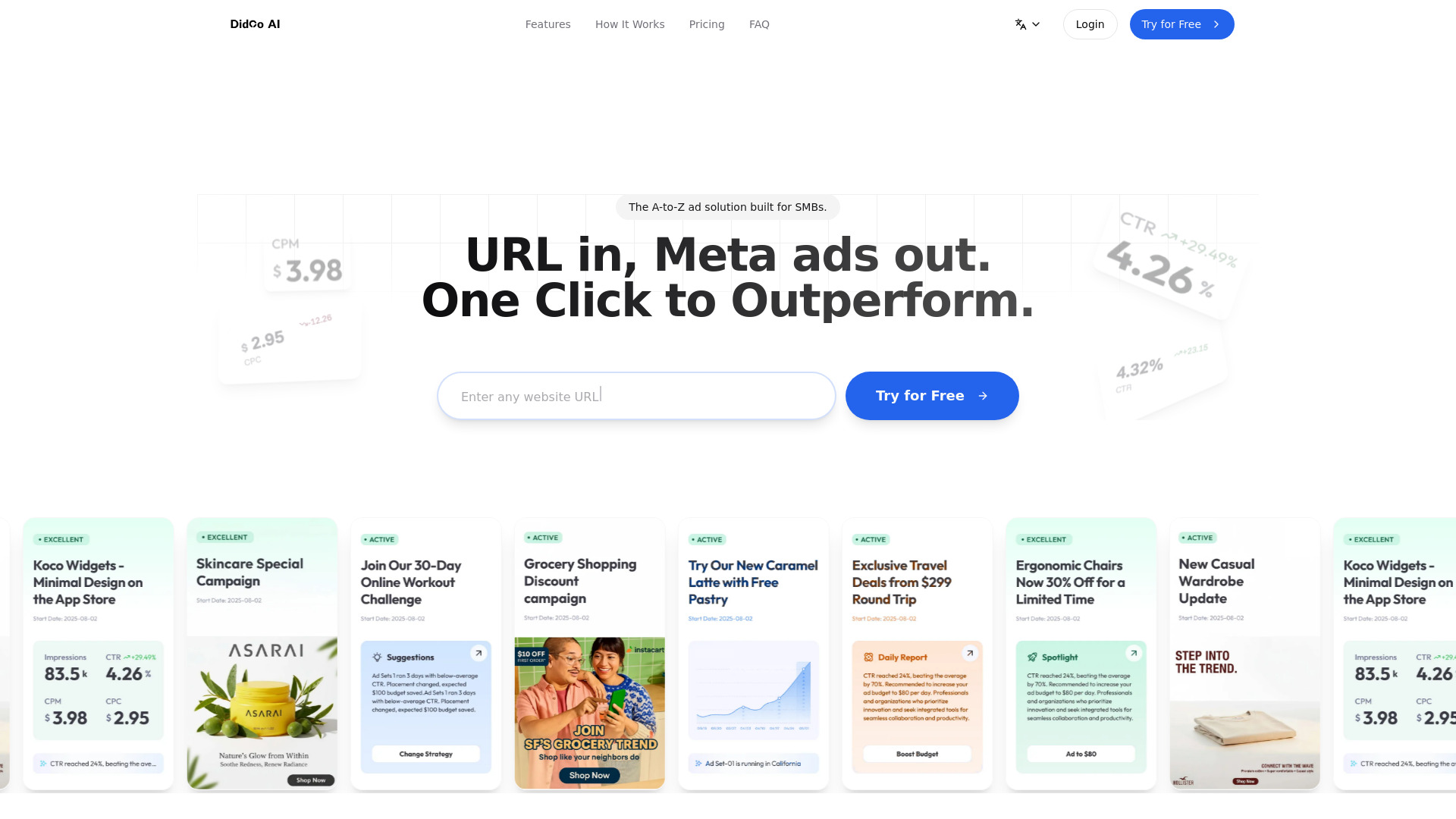
Didoo AI has a sharply defined workflow: give it a URL, and it builds, launches, targets, and optimizes Meta ads. That focus is useful for an SMB that does not want to assemble separate tools for ad copy, creative, audience targeting, and budget management. It can generate the ad creative and copy while handling 24/7 optimization. Compared with broader content platforms, Didoo is easier to understand because the output is tied to a specific distribution channel. That same focus is also the reason it should not be treated as a general AI-search tool.
Best for
SMB owners who primarily advertise on Facebook and Instagram
Teams that want URL-to-campaign automation
Marketers looking for automated audience and budget optimization
Limitations
It focuses exclusively on Meta Ads rather than other ad platforms
Monthly and quarterly pricing are presented in a potentially confusing way
Full campaign automation may be a poor fit for teams requiring detailed manual controls
Shortlist signal: Choose Didoo AI when Meta is your main acquisition channel and you want the shortest route from landing page to campaign.
5. Searchify

- SEO professionals
- Free analysis; no sign-up required
- Starts at Check vendor pricing
- Usage signal: 3.5K
Why it matters
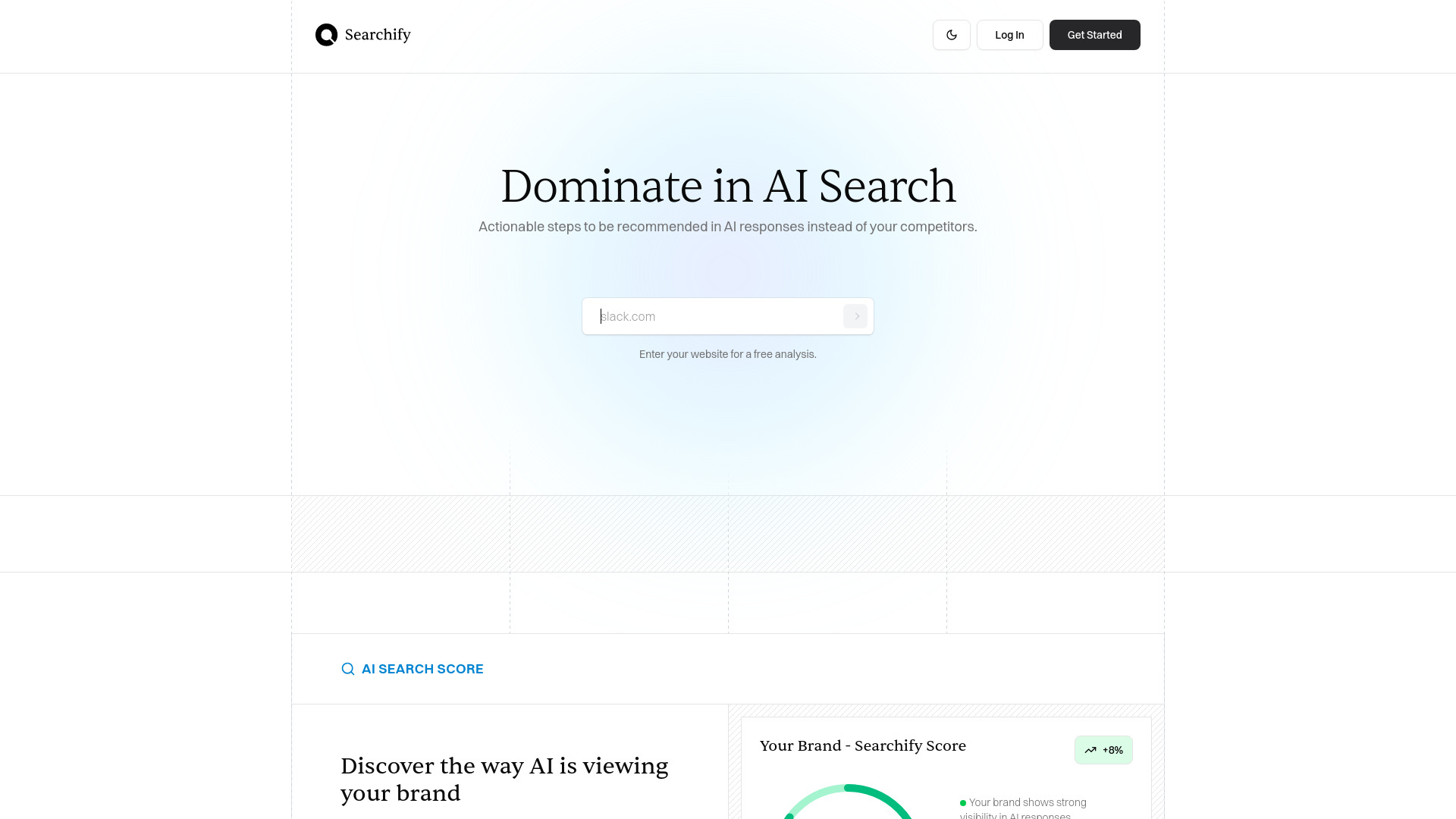
Searchify is the clearest direct match for creators asking how their work appears in AI-generated answers. Its AI Search Score gives the workflow a starting point, while actionable recommendations turn a vague visibility concern into a list of changes to investigate. The content-creation component matters too: analysis is more useful when it leads to edits rather than a report that sits in a folder. A free analysis with no sign-up lowers the cost of testing the fit. Before making it part of a recurring process, confirm current pricing and exactly which AI search platforms and tracking limits apply.
Best for
SEO professionals monitoring AI-response visibility
Content teams that need prioritized recommendations
Creators who want to test an analysis before creating an account
Limitations
Current pricing and workflow limits should be verified with the vendor
A score is a diagnostic, not a guarantee that a page will be cited
It may require a separate writing or production tool to implement recommendations
Shortlist signal: Start with Searchify when you need a direct read on AI visibility before changing your content process.
6. ContentIQ

- Founders
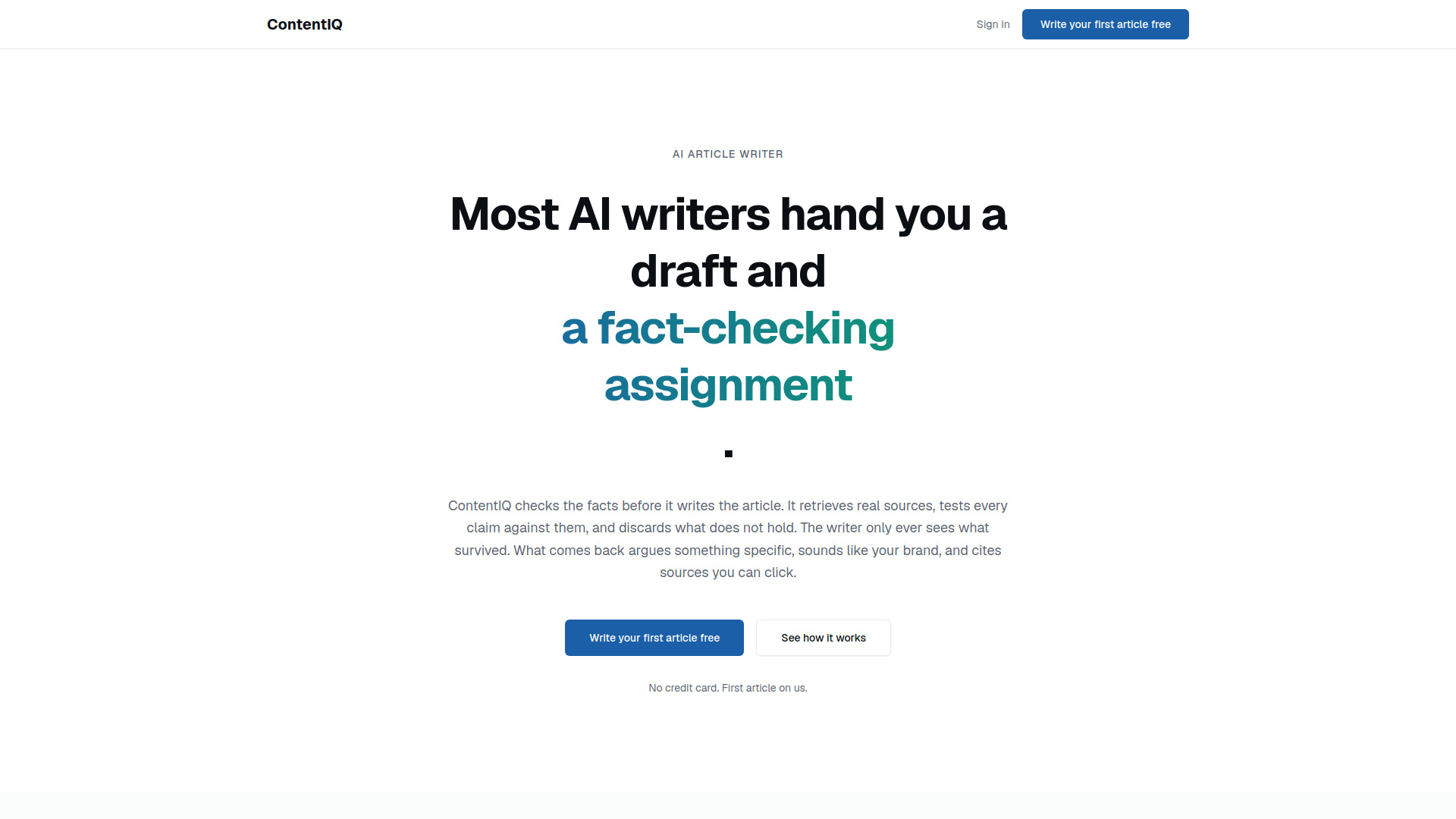
- First article free; fact-checked writing; clickable sources
- Starts at Single brand: $39/month
- Usage signal: Usage signal not listed
Why it matters
ContentIQ tackles a problem that AI-search scores cannot solve on their own: whether the underlying article is trustworthy, specific, and recognizably yours. It validates claims against live sources before drafting, then presents linked sources and verification counts in a source panel. Its one-time Brand Profile setup is designed to keep voice and positioning consistent, which is useful for founders who need to publish without sounding like every other AI-assisted site. The first article is free, giving you a sensible way to inspect the fact-checking workflow before paying $39/month for a single brand.
Best for
Founders publishing research-heavy articles
Small teams that need citations and consistent positioning
Writers trying to reduce generic language and unsupported claims
Limitations
Initial setup requires building a brand profile
Continued use beyond the first free article requires a paid plan
Source verification still deserves human review for important claims
Shortlist signal: Add ContentIQ when factual support and brand voice matter more than generating the highest possible volume.
7. BukiTools
- Content Writers
- Free forever; no sign-up or credit card required
- Starts at Free: $0
- Usage signal: Usage signal not listed
Why it matters
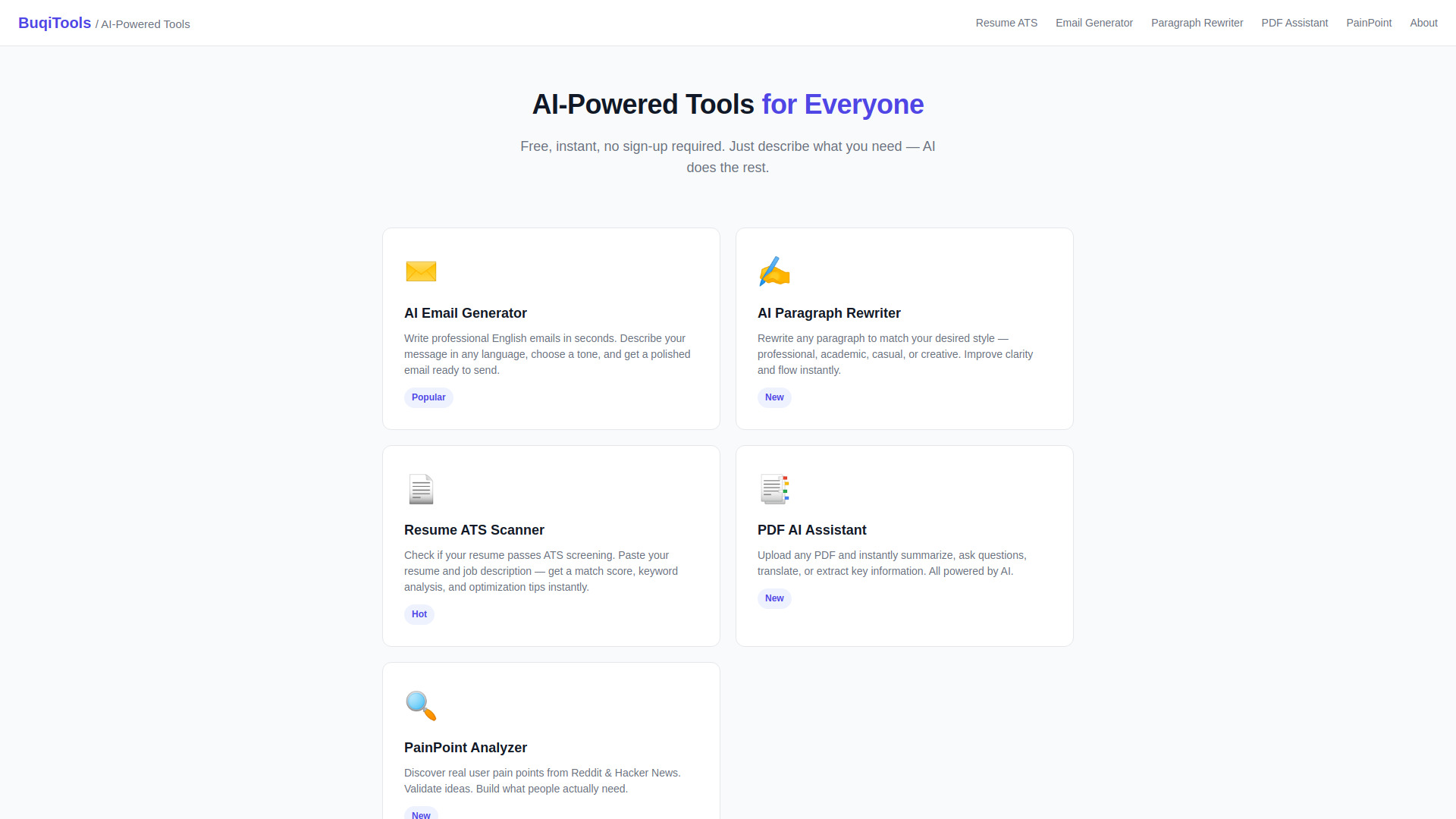
BukiTools is the practical utility option in this list. It bundles five AI tools without registration, including a Resume ATS Optimizer, Email Generator, Paragraph Rewriter, PDF AI Assistant, and PainPoint Analyzer. That mix is broader than search optimization, but it can remove small workflow interruptions for writers who need to rewrite a passage, inspect a PDF, or generate a professional email without opening another paid subscription. Its privacy-first positioning says no data is stored, and the free-forever model makes it easy to use as a supplementary toolkit rather than a central content system.
Best for
Writers who want lightweight utilities with no account setup
Creators handling mixed writing, PDF, and communication tasks
Users who need a free companion to a dedicated visibility platform
Limitations
The suite is limited to the tools listed on the site
There are no pricing tiers or advanced plans for expanding the workflow
It does not provide a dedicated AI-search score or monitoring system
Shortlist signal: Keep BukiTools nearby when you need free, low-friction writing utilities rather than an end-to-end optimization platform.
8. ai influencer generator

- Solo creators
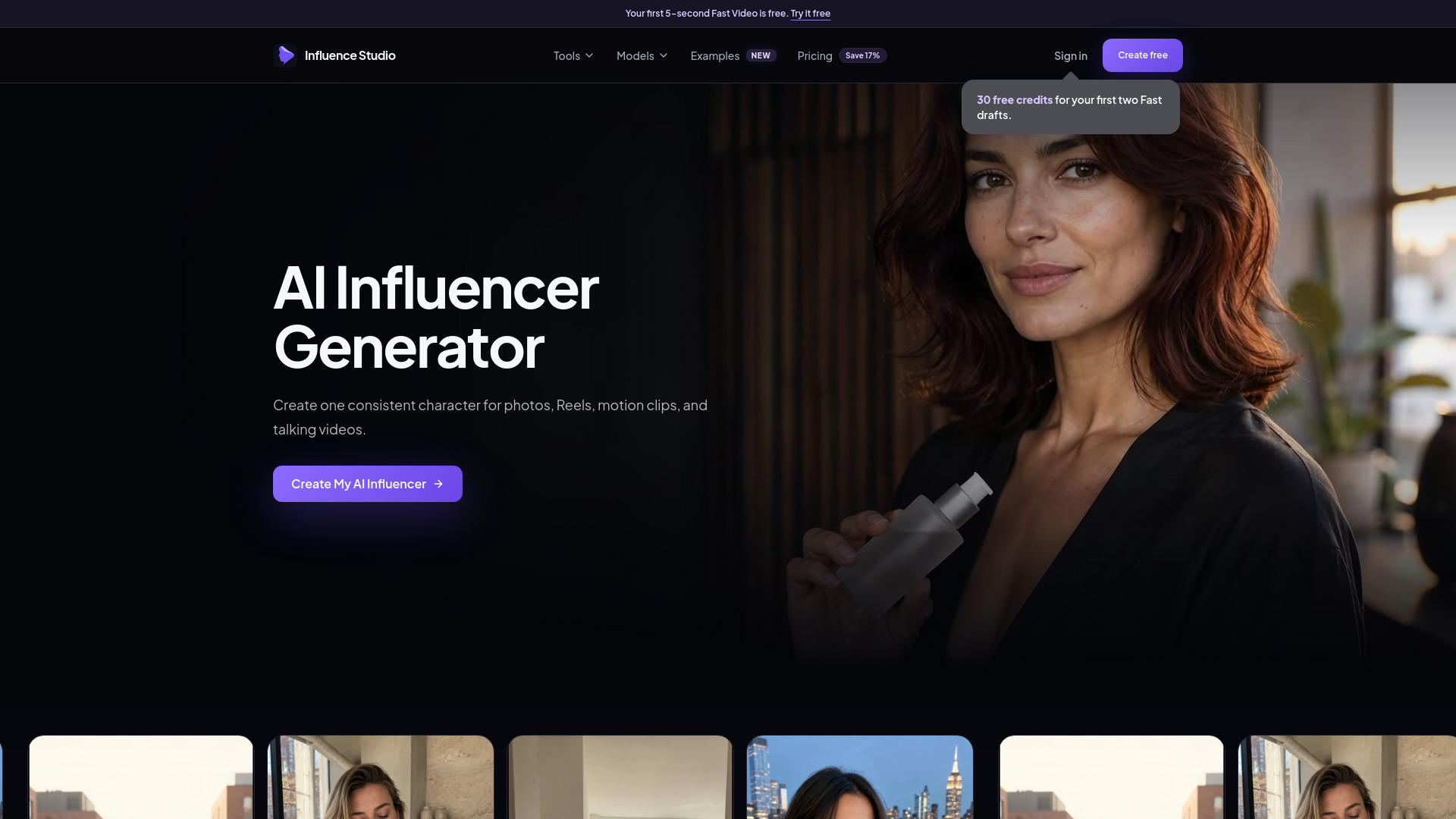
- 30 free credits and 1 free 5-second Fast Video
- Starts at Starter: $15.83/month billed annually
- Usage signal: Usage signal not listed
Why it matters
A recognizable visual identity can make a content system easier for audiences to remember, and ai influencer generator is built around that idea. It creates a reusable AI influencer character, supports consistent character photos, and turns images into short social clips. The Fast, Consistent, Motion, and Talking modes give solo creators several ways to reuse the same identity without commissioning a new shoot for every post. This is an adjacent visual studio, not a search analytics product, but it can support a distinctive content series that feeds social discovery and brand recognition.
Best for
Solo creators building a recurring virtual personality
Social campaigns that need character continuity across posts
Teams producing short image-to-video clips from a shared identity
Limitations
Both image and video generation consume credits
The free offer is limited to initial credits and Fast Video trials
Heavy publishing schedules may require close monitoring of credit usage
Shortlist signal: Choose this tool when consistent character-led content is central to how you attract and retain an audience.
9. Inspix AI

- Content creators
- AI video and image creation; cinematic videos; stunning visuals
- Starts at Basic (Monthly): $19/month
- Usage signal: Usage signal not listed
Why it matters
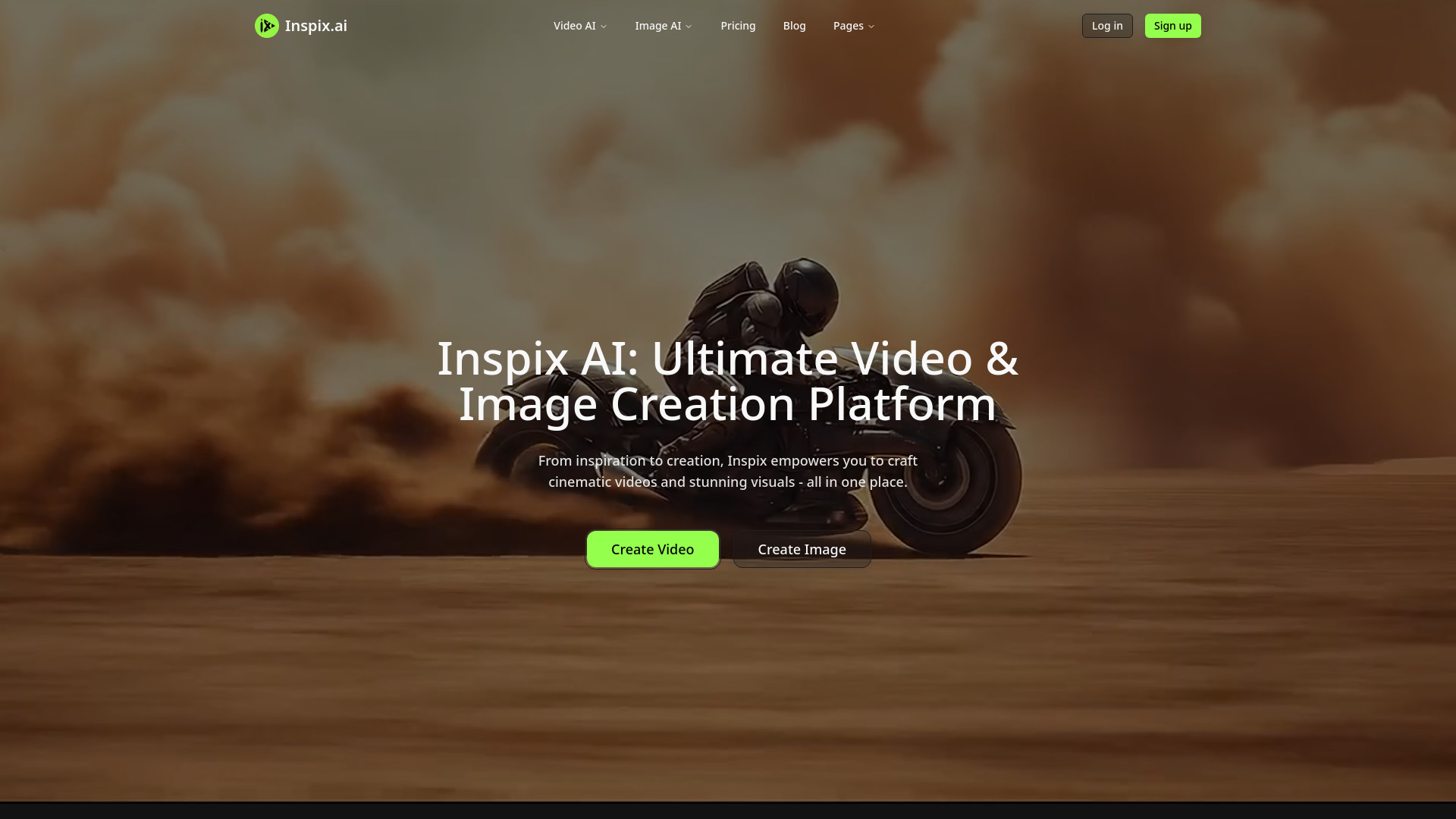
Inspix AI keeps the creative brief straightforward: text-to-video, image-to-video, and text-to-image in one platform. That combination is useful when a creator wants to turn a written concept into a visual sequence, animate an existing still, or create a supporting image without switching products. The Basic plan is listed at $19/month with 300 credits and 100 videos, though the credit model means the headline allowance will depend on the work you ask it to do. It is a production companion for content campaigns, not a substitute for search visibility analysis.
Best for
Creators producing short-form visual content from text prompts
Teams repurposing still images into motion
Users who want video and image generation under one subscription
Limitations
Full features and higher limits require a paid subscription
Credit-based use can become difficult to forecast for heavy users
"100 videos" should be evaluated alongside the credit cost of each generation
Shortlist signal: Put Inspix AI on the shortlist when visual production, especially image-to-video work, is slowing your publishing schedule.
10. seedeo

- Content creators
- 10 free credits; video, image, music, and voice generation
- Starts at Check vendor pricing
- Usage signal: Usage signal not listed
Why it matters
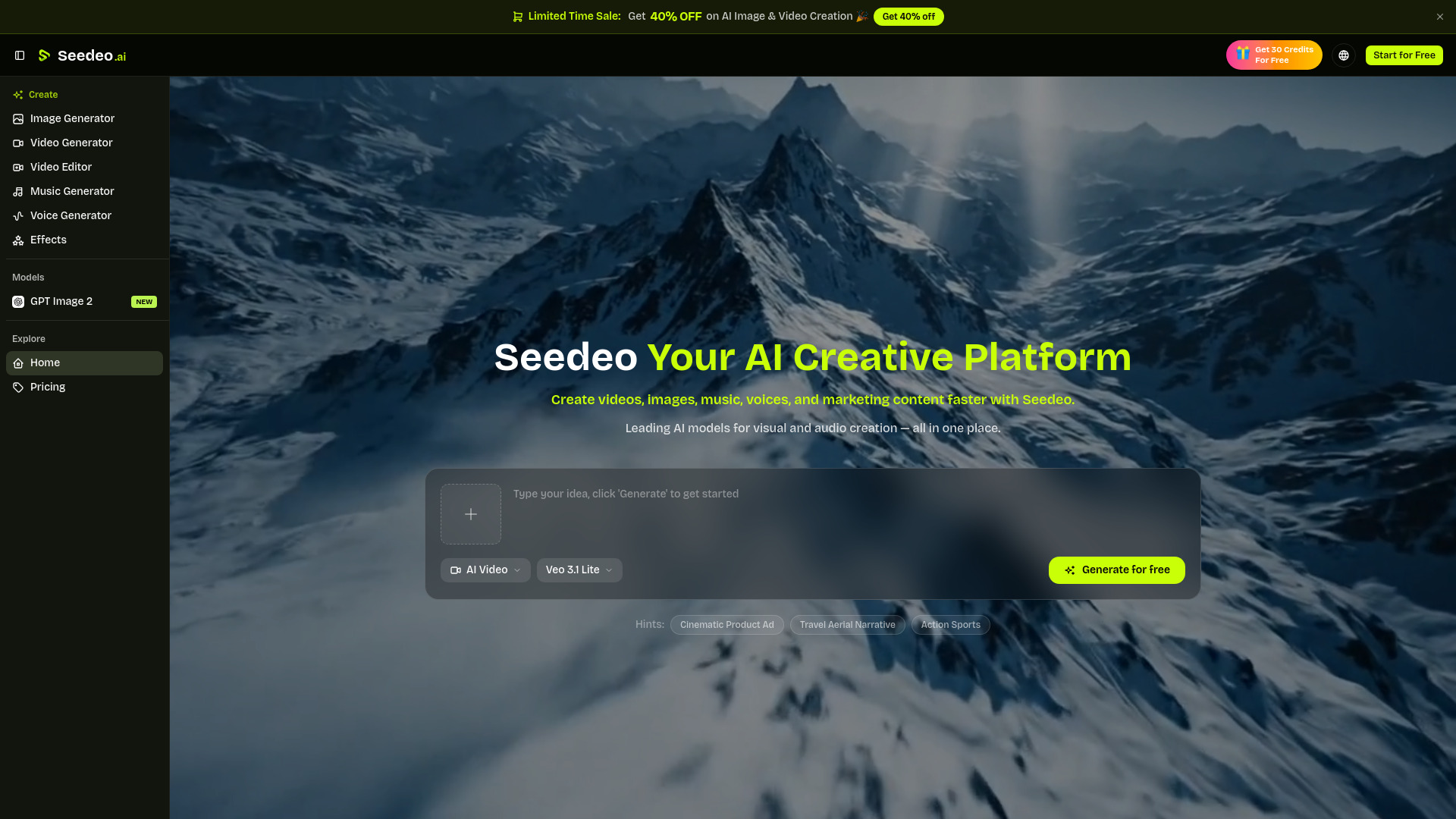
seedeo is the broadest media option here, combining AI video, image, music, and voice generation with creative AI effects. That breadth can be useful for creators assembling a complete short-form package: visuals, narration, and audio in one place. Ten free credits provide a low-commitment starting point, and the possibility of earning additional credits may help occasional users experiment before paying. The catch is purchasing clarity. Detailed pricing is not presented on the homepage, and credit-based usage can make recurring production costs harder to predict.
Best for
Creators who need video, images, music, and voice in one workspace
Experimental projects combining several media types
Occasional users who want free credits to explore a broad toolset
Limitations
Detailed pricing is not provided on the homepage
Credit-based usage may constrain heavy production
It is a media-generation platform rather than a dedicated search-optimization product
Shortlist signal: Try seedeo when your content requires several media formats and you are willing to validate pricing before building a regular workflow.
What to test before choosing
Run the same small content brief through the tools that match your segment. Do not judge them on a generic demo prompt. Use a topic you genuinely publish about, include a real audience, and define the output you need.
For Searchify: Check whether its AI Search Score and recommendations identify issues you can actually act on, and note which platforms it covers.
For ContentIQ: Submit a topic with several claims and inspect the linked sources, verification counts, and resulting voice after creating a Brand Profile.
For creative studios: Generate one image, one short video, and one revision. Record credits used, output quality, watermark behavior, and how much prompt iteration was required.
For AppLaunchFlow: Build one listing and test preview versus export behavior, screenshot formats, illustrations, and localization limits.
For ad automation: Use the trial to inspect how much campaign control remains with you, which platforms are supported, and how budgets are reallocated.
For free utilities: Test privacy expectations and whether the available tools cover your actual recurring tasks rather than just a one-time need.
Pricing deserves its own test. Several products use credits, trials, or platform-specific limits. A low monthly price can still be expensive if the content format you produce consumes credits quickly. Conversely, a higher-priced system may be reasonable if it replaces several manual steps your team currently pays for elsewhere.
What to do next
Start with the narrowest problem that is blocking publication. If you cannot tell whether your content is appearing in AI responses, begin with Searchify. If your articles lack reliable sourcing or a consistent brand position, test ContentIQ. If the strategy is clear but you cannot produce enough supporting assets, compare AI Inspo with Inspix AI or seedeo.
Then create a two-tool pilot rather than subscribing to the entire list. A sensible first pairing is one diagnostic or writing tool plus one production tool. For example, Searchify can identify visibility opportunities while AI Inspo helps package a campaign; ContentIQ can improve evidence quality while AppLaunchFlow serves an app-specific distribution channel. Keep the pilot small enough that you can compare outputs, time saved, and actual publishing results.
Finally, verify live vendor pricing and cancellation terms. The figures above are useful starting points, but trials, credit quotas, export rules, and plan names can change. Treat the first month as a workflow test, not a permanent commitment.
Common mistakes when choosing from a complex top list
Treating every tool as an AI-search platform. Searchify directly targets AI visibility; the creative, ad, and app-store products solve adjacent discovery problems.
Confusing generation with optimization. Producing more content does not automatically make it more discoverable or more useful.
Ignoring evidence quality. A polished draft can still contain unsupported claims. Source validation should be part of the selection process for research-led publishing.
Comparing free plans by label alone. "Free" can mean weekly quotas, preview-only exports, initial credits, a single article, or a short trial.
Missing channel restrictions. Didoo AI is focused on Meta Ads, while AppLaunchFlow is focused on app-store assets. Their narrowness is useful only when it matches your channel.
Overlooking credit economics. Image, video, music, and voice generations may consume credits at different rates. Test your real format before estimating monthly cost.
Delegating strategy without a review loop. Autonomous ad optimization can save time, but teams still need to inspect targeting, budget movement, claims, and brand fit.
Choosing a broad suite when one focused tool is needed. A multi-tool website may be convenient, but it will not necessarily replace a dedicated visibility monitor or evidence-led writing workflow.
FAQ
Searchify is the most direct fit for measuring and improving visibility in AI-generated responses. ContentIQ is a strong companion for fact-checked, cited writing. The other tools in this guide are adjacent options that help with app-store discovery, paid distribution, or the visual assets needed to support a content strategy.