
The phrase ai generative expand top providers points to a category that is broader-and messier-than it first sounds. Some tools focus on creating or editing images from prompts and references; others bundle video, audio, 3D assets, or multiple AI models into one workspace. We compared 10 providers to help you build a practical shortlist, while keeping an important distinction in view: the tools here support adjacent generative-creation workflows, but not every provider specifically advertises image outpainting or canvas expansion. If expanding an image beyond its original borders is the job, verify that exact workflow before paying.
Start here
Start with the workflow, not the ranking number. For a creative team that wants to try several model types in one place, FLORA is the most versatile first stop. For a designer primarily creating or editing still images, compare Seedream 5.5 AI, Gpt Image 2.5, and Image 2.5. If your brief is actually video, 3D, or an interactive world, the more specialized picks below will be a better fit than an image-focused editor.
One caveat deserves to be front and center: none of the supplied product descriptions explicitly promises outpainting or generative canvas expansion. Treat this guide as a map of adjacent generative tools-not proof that every pick can extend an image past its edges. Before adopting one for that job, test a real image and confirm the output preserves the subject, lighting, perspective, and composition you need.
| Your first priority | Start with | Why it belongs on the shortlist |
|---|---|---|
| One workspace for several creative model types | FLORA | More than 50 image, video, and text models, plus team collaboration |
| Prompt- and reference-led image creation | Seedream 5.5 AI | Multiple image workflows and native 4K on supported models |
| Video generation from text, images, or references | SeeGen AI | Several video model families and multiple input approaches |
| 3D assets from text or photos | ModelGenerator | Textured GLB exports with PBR materials |
Segment comparison
These products do not all compete for the same task. The comparison below separates the main workflow from the best reason to investigate each tool. Use it to narrow the field, then check the ranked notes for costs and caveats.
| Segment | Provider | Standout workflow | Main thing to verify |
|---|---|---|---|
| Multi-model creative platform | FLORA | Build image, video, and text workflows across 50+ models | Credit use for the models and generations you need |
| Image generation and editing | Seedream 5.5 AI | Combine prompts and reference images; supported models offer native 4K | Which model and settings consume credits |
| Video and image generation | SeeGen AI | Generate from text, images, frames, and multiple references | Discord requirement for free credits and variable video costs |
| Broad creator suite | Photogenerator AI | Image, video, audio, and character-related features in one service | Whether 10 monthly free credits cover your tests |
| 3D creation | ModelGenerator | Create textured 3D assets from text or images | Pricing and how much mesh cleanup your pipeline needs |
Shortlist paths
A useful shortlist is usually three tools, not ten. Choose candidates that match the same input, output, and review process; otherwise, you are comparing unlike products. These paths give you a more focused starting point.
| If your project looks like this | Compare these providers | Decision test |
|---|---|---|
| A team needs to explore several creative models | FLORA, Generor, Photogenerator AI | Can everyone use the same workflow, and can you predict usage costs? |
| Still images need generation or reference-based edits | Seedream 5.5 AI, Gpt Image 2.5, Image 2.5 | Does the tool preserve the details you cannot afford to change? |
| The deliverable is a video or interactive scene | SeeGen AI, AI World Generator | Does it support your intended input and the level of control you need? |
| You need generated 3D assets or an API layer | ModelGenerator, GPT Image 2.5 | Are you buying an asset-making interface or developer infrastructure? |
Ranking snapshot
Scores are useful for sorting, but they do not make a video platform interchangeable with an image editor. Read "best for" as a guide to the tool's strongest stated audience, and use the signal column as a rough measure of site traffic rather than a quality rating.
| Rank | Provider | Score | Best for | Monthly visits |
|---|---|---|---|---|
| #1 | FLORA | 92/100 | Creative teams | 709.4K |
| #2 | Seedream 5.5 AI | 91/100 | Graphic designers | 81.9K |
| #3 | SeeGen AI | 91/100 | Content creators | 35.2K |
| #4 | Photogenerator AI | 91/100 | Photographers | 12.8K |
| #5 | AI World Generator | 90/100 | Game studios | 4.3K |
| Rank | Provider | Score | Best for | Monthly visits |
|---|---|---|---|---|
| #6 | Generor | 90/100 | Content creators | 1.1K |
| #7 | GPT Image 2.5 | 90/100 | AI application developers | 2.0K |
| #8 | Gpt Image 2.5 | 88/100 | Independent designers | Not listed |
| #9 | ModelGenerator | 88/100 | Game developers | Not listed |
| #10 | Image 2.5 | 88/100 | Graphic designers | Not listed |
How we grouped and ranked the list
This is a complex category, so we ranked for useful workflow coverage rather than pretending every product is a direct substitute. The list spans multi-model creative workspaces, image generation and editing, video tools, 3D asset creation, and developer-facing model access. That breadth helps readers identify the right segment; it also means the rank alone cannot tell you whether a product fits a particular production brief.
We weighed the stated feature set, the audience each tool appears designed for, the practical reach of its workflows, and market signals such as monthly visits. A high score reflects a strong case for shortlisting within this mixed field, not a guarantee of output quality for every prompt. Where a listed limitation affects cost or control-such as credits, variable generation rates, or external API dependence-we call it out rather than burying it in a pricing footnote.
Most importantly, "generative expand" can mean two different things: broadening a creative project with generative AI, or specifically extending an image canvas through outpainting. The product facts support the first interpretation across these picks; they do not establish that every service performs the second. If literal image expansion is your requirement, make it a pass/fail test in a free trial or demo, and ask the vendor about native outpainting rather than assuming image generation includes it.
Ranked field notes
1. FLORA

- Creative teams building shared multi-model workflows
- 1,000 starter credits
- Starts at Free; paid plans from $18/month
- Usage signal: 709.4K
Why it matters
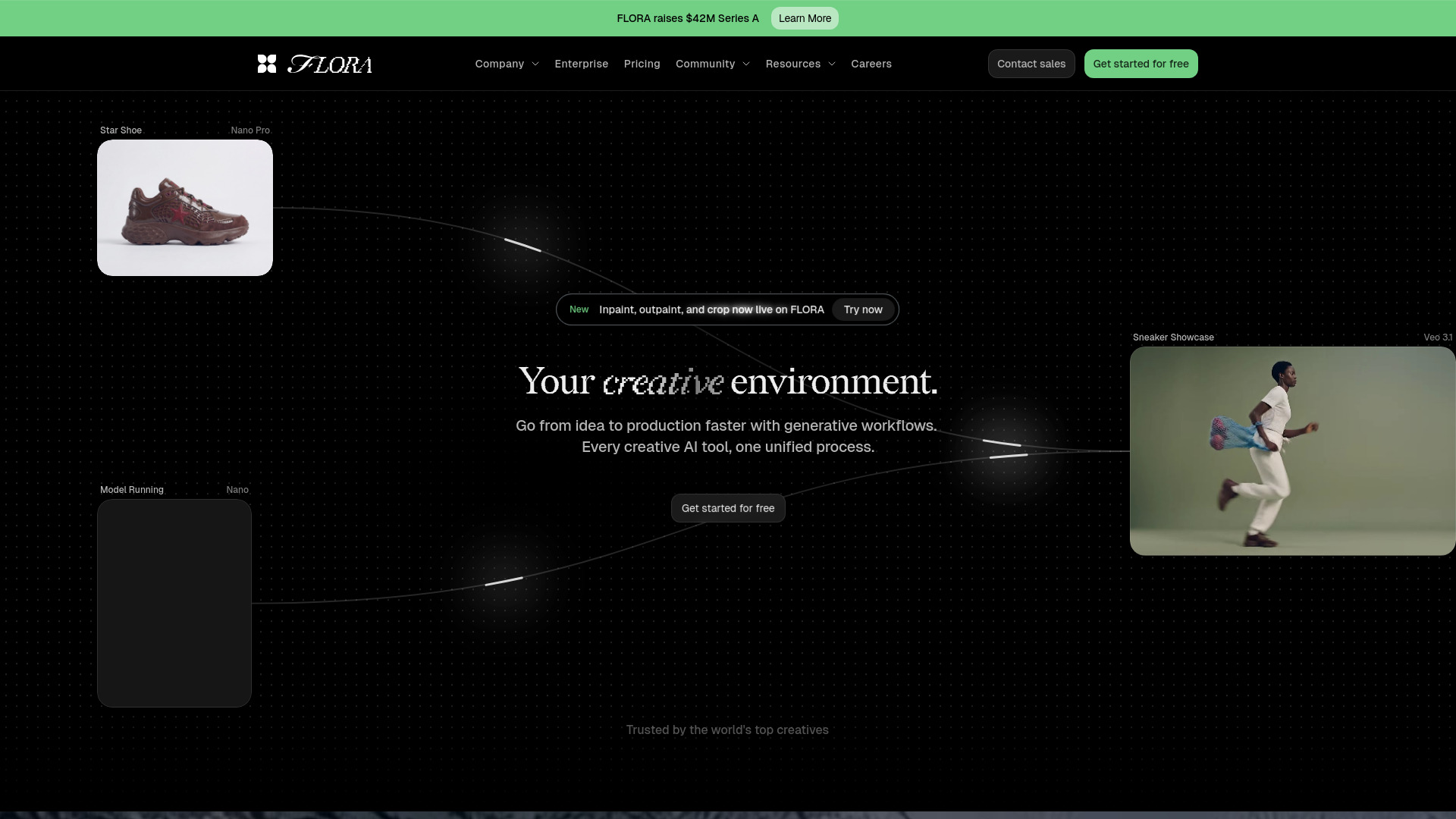
FLORA earns the first spot by bringing more than 50 image, video, and text models under one subscription, which gives creative teams room to compare approaches without stitching together a separate account for every model. Its unified workflows are aimed at production teams, and unlimited team members on all plans make the collaboration model especially appealing when projects involve several contributors. For a broad generative-expansion brief-one that might move from a visual draft to video or supporting text-this is the most adaptable starting point in the field. The trade-off is that "one subscription" does not mean one predictable generation cost: credits still need monitoring, and premium features move behind a paid plan after starter credits run out.
Best for
Creative teams that want access to many model types in one place.
Production workflows where shared collaboration matters more than seat-count limits.
Teams testing different image, video, and text approaches before standardizing.
Limitations
Credit consumption varies across models, so estimate costs using your own generation mix.
Premium features require a paid subscription once the starter credits are used.
Its breadth does not itself confirm a dedicated outpainting workflow; test that task specifically.
Shortlist signal: Put FLORA on your shortlist when a team needs one collaborative workspace to explore many image, video, and text models.
2. Seedream 5.5 AI

- Designers creating prompt- and reference-led images
- Free credits for new users; no card required
- Starts at $7.99/month
- Usage signal: 81.9K
Why it matters
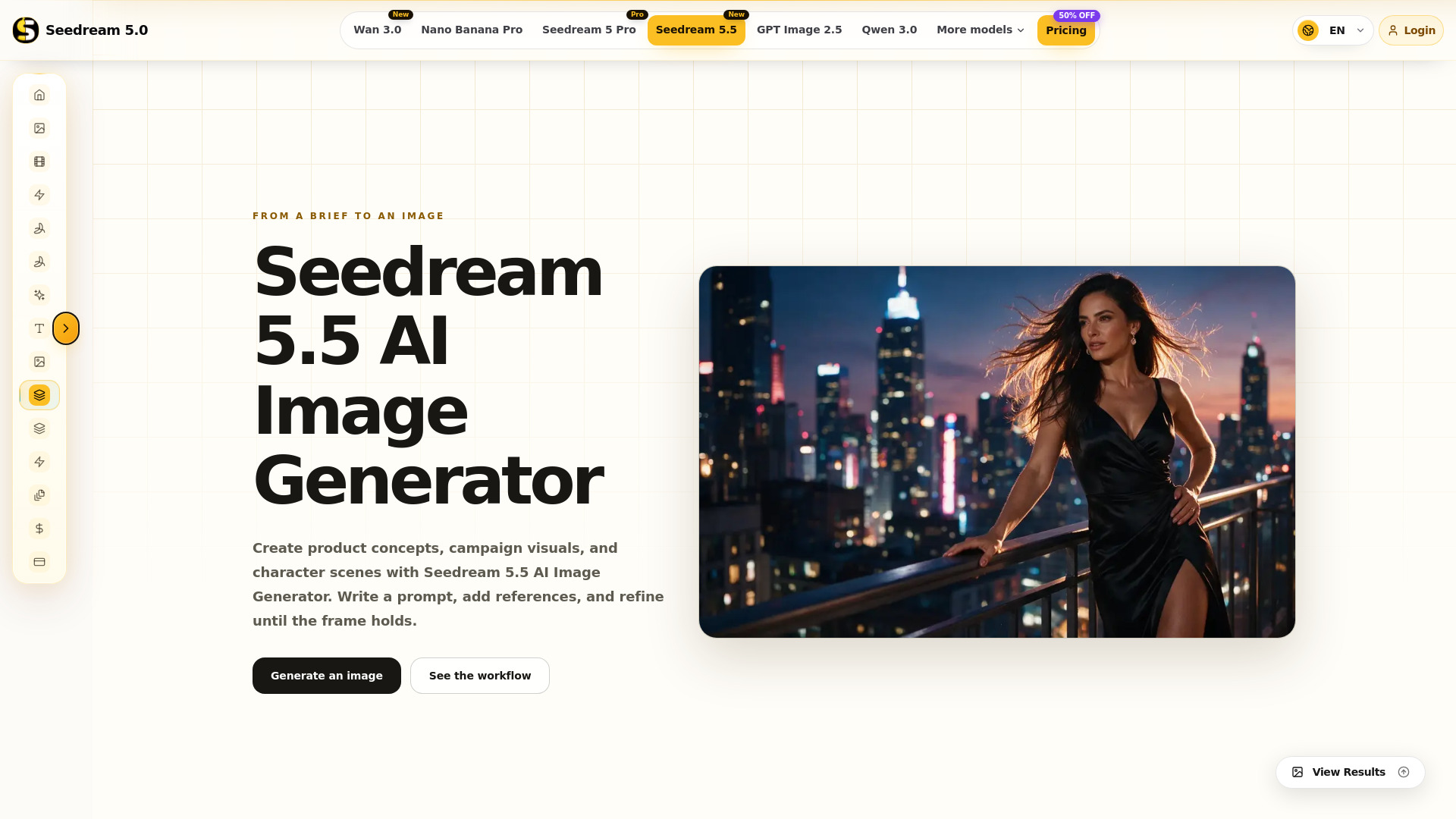
For still-image work, Seedream 5.5 AI keeps the input options practical: start with a text prompt, bring in a reference image, or try a different image-generation model or workflow. Native 4K output is available on supported models, making resolution a meaningful part of the comparison rather than an afterthought. New users can try it with free credits without providing a credit card, which lowers the friction of evaluating the interface and output. The caveat is that the free-credit quantity is not specified, and generation estimates depend on the model and settings. A "4K" label is not a substitute for testing whether a particular model produces the composition and detail your deliverable requires.
Best for
Graphic designers comparing prompt-based and reference-image creation.
Users who want to test multiple image-generation models in one platform.
Projects where high-resolution output matters and the chosen model supports it.
Limitations
The amount of free credit is not stated, so plan a small, focused evaluation.
Credit estimates vary with model and settings; the standard two-credit image estimate is not universal.
Confirm that the workflow you need is supported rather than inferring it from general image generation.
Shortlist signal: Choose Seedream 5.5 AI when reference-led image creation and supported 4K output are more important than a guaranteed, fixed free quota.
3. SeeGen AI

- Creators producing AI video from multiple input types
- 200 free credits; Discord signup required
- Starts at Free plan: $0
- Usage signal: 35.2K
Why it matters
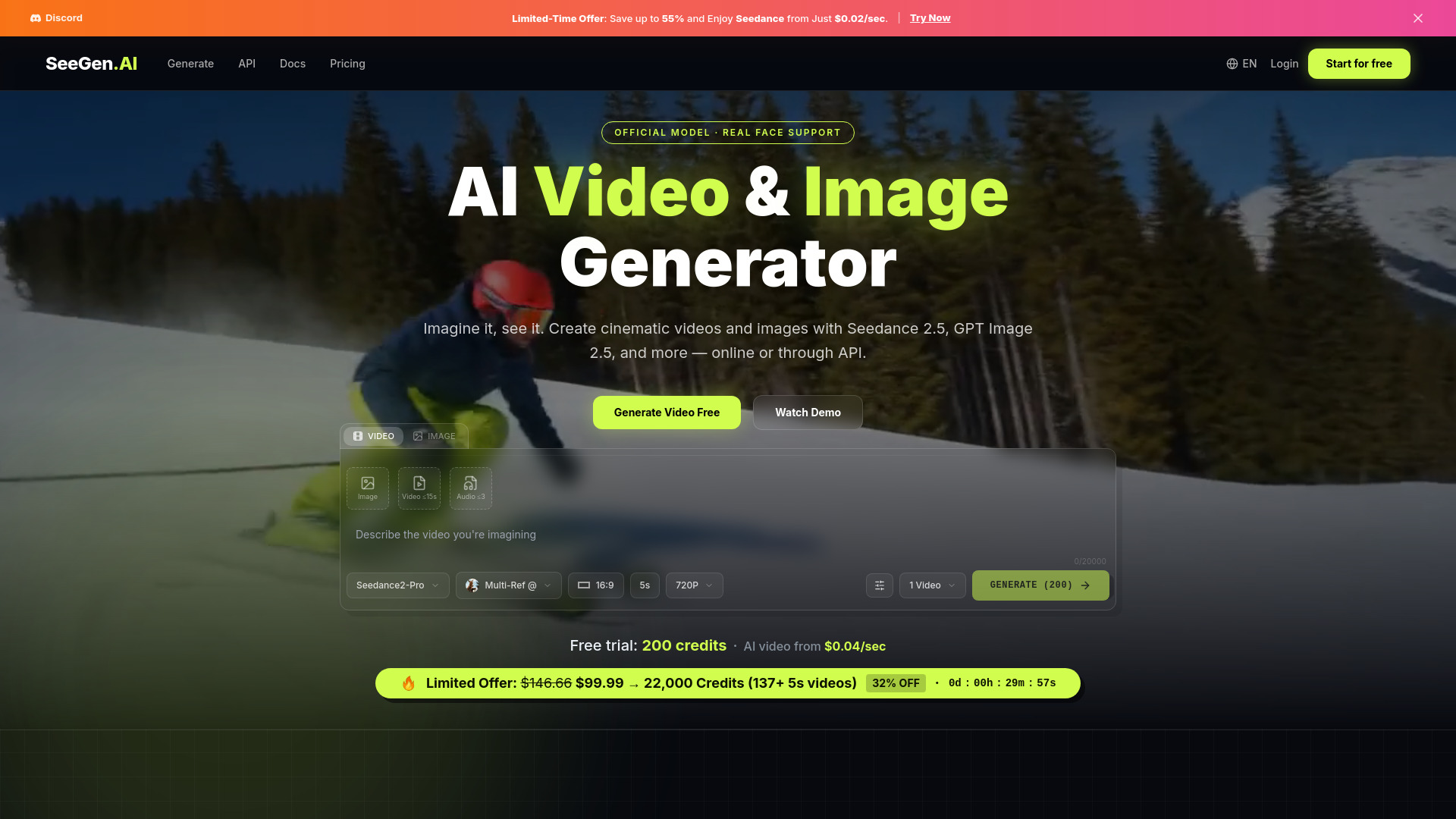
SeeGen AI is the clearest video-first option in this group. Its model lineup includes Seedance 2.5, several Seedance 2.0 variants, Wan 3.0 options, and Grok Imagine Video. The range matters because the platform supports more than a single text prompt: workflows include text-to-video, image-to-video, frames, and multiple references. That makes it worth testing when a creator needs several routes into a clip rather than a single, narrow generator. SeeGen also describes video editing and upscaling among its capabilities. The operational catch is real: free credits require signing up and joining Discord, and paid generation costs vary with the model, resolution, duration, and reference-video length. Budget only after running the kind of clips you expect to make.
Best for
Content creators exploring several video-generation models in one service.
Projects that begin from text, images, frames, or multiple references.
Teams that want to compare model outputs before settling on a video workflow.
Limitations
Accessing the free credits requires both an account and joining Discord.
Video cost changes with model, resolution, duration, and reference-video length.
A long model list still requires hands-on testing to find the right fit for a particular clip.
Shortlist signal: Shortlist SeeGen AI when video is the deliverable and you want to compare multiple models and input methods before committing.
4. Photogenerator AI

- Photographers exploring a broad AI creator suite
- 10 credits/month; login required
- Starts at Free: $0/month
- Usage signal: 12.8K
Why it matters
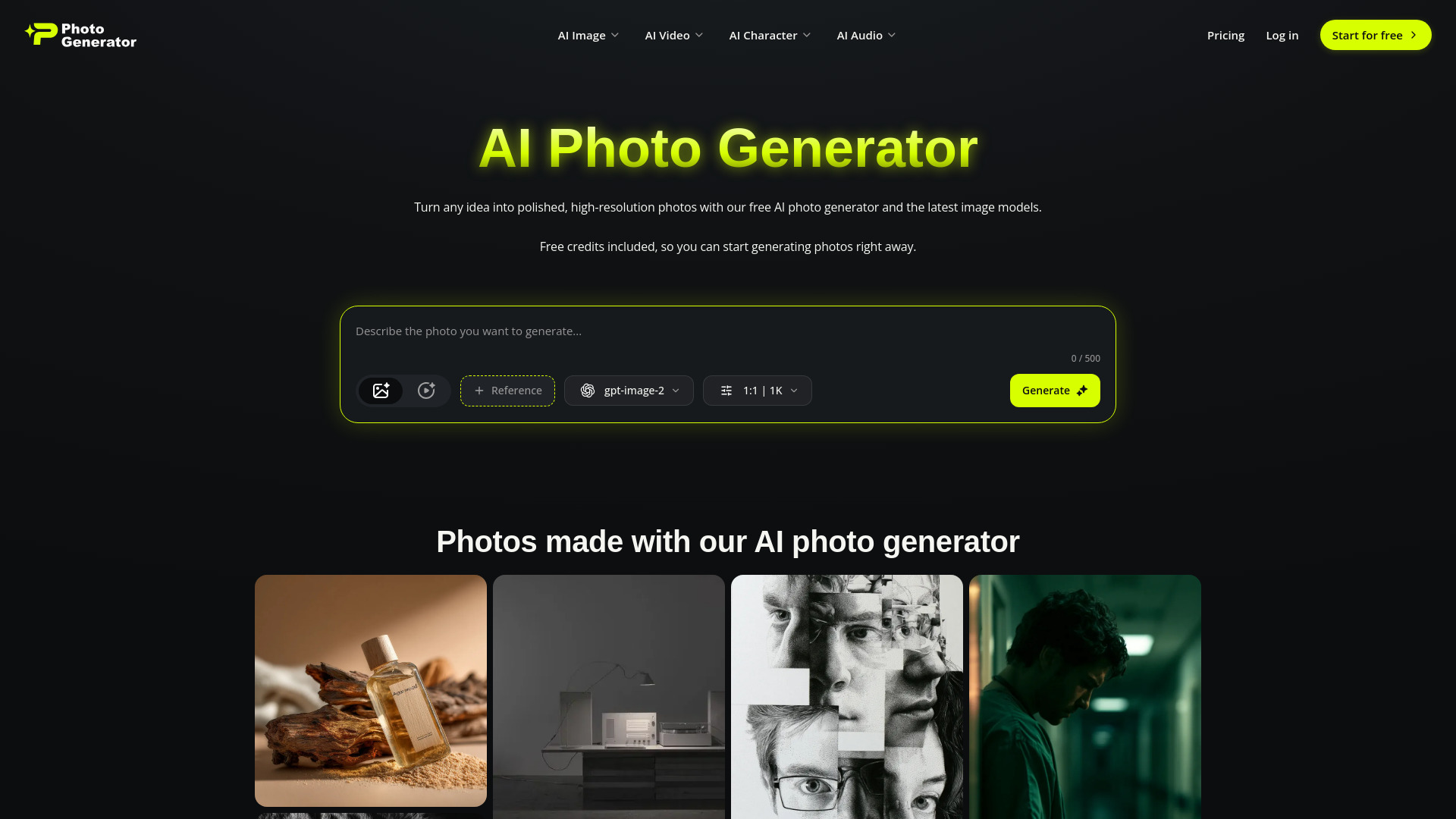
Photogenerator AI takes the all-in-one route: its feature set reaches beyond still images into a cinematic video suite, audio generation, voice-over and voice-cloning tools, and virtual-character features. On the image side, the listed capabilities include text-to-image, image-to-image editing, face swap, and 4K upscaling. That breadth may save a creator from jumping between specialized services when a project needs several asset types. But breadth is not the same as depth for every task. The free plan gives 10 credits per month and requires a login, so it is better treated as a limited evaluation than an open-ended production allowance. Photographers should test the precise image-editing controls they need before relying on the broader suite.
Best for
Photographers and creators who want image tools alongside video or audio features.
Small projects that involve several kinds of AI-generated media.
Users who prefer to evaluate an all-in-one service before paying.
Limitations
The free plan is limited to 10 credits monthly and requires login.
A broad feature list does not establish equal control or quality across every media type.
Check the specific editing workflow and output options against your production requirements.
Shortlist signal: Add Photogenerator AI when your work spans images and other media and you value a broad suite over a single-purpose editor.
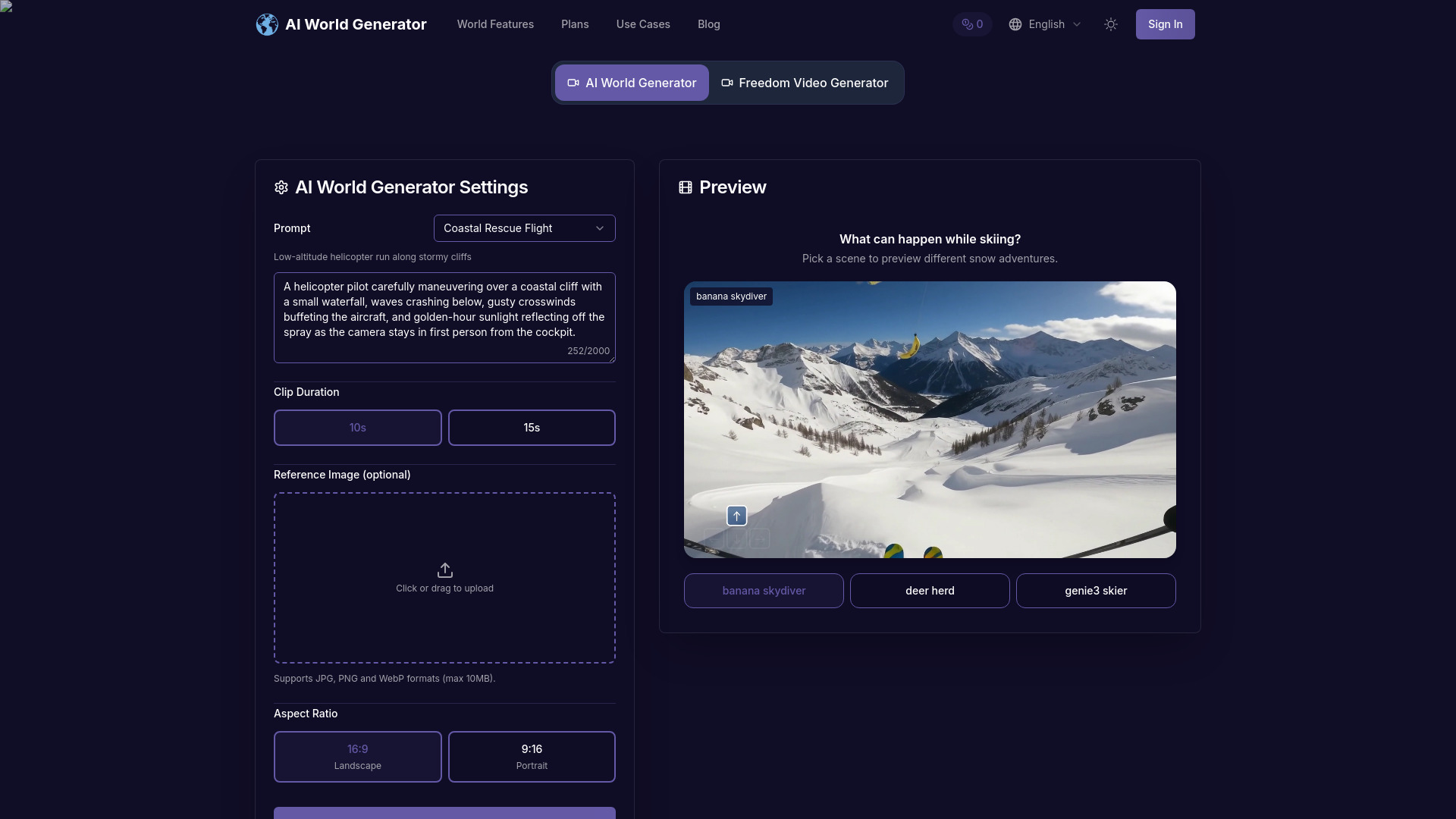
5. AI World Generator

- Game studios prototyping interactive 3D worlds
- 6 free world-builder credits
- Starts at Free: $0/month
- Usage signal: 4.3K
Why it matters
AI World Generator is not an image editor dressed up as a world tool. Its central idea is to turn text into explorable spaces in real time, with a stated 24 FPS experience, then let users prompt world events such as changes to weather, lighting, or characters. Persistent world memory is intended to maintain spatial continuity and narrative state for several minutes, which is a more specialized proposition than producing a static asset. That makes the platform an interesting fit for game studios and interactive-world prototypes. It also has boundaries: memory gradually fades during very long runs, the action space is constrained, and multi-agent choreography remains experimental. Treat it as a prototyping option, not proof that an open-ended production world is solved.
Best for
Game studios exploring text-driven, explorable 3D environments.
Prototypes where promptable events and short-session continuity are useful.
Teams testing interactive world concepts before investing in a fuller pipeline.
Limitations
World memory can drift during very long sessions.
The available action space is constrained, and multi-agent choreography is experimental.
Its real-time world workflow is adjacent to-not a replacement for-image canvas expansion.
Shortlist signal: Try AI World Generator when the project calls for an interactive environment, not simply a larger or edited still image.
6. Generor

- Content creators sampling different generator types
- Starts at Basic: $15
- Usage signal: 1.1K
Why it matters
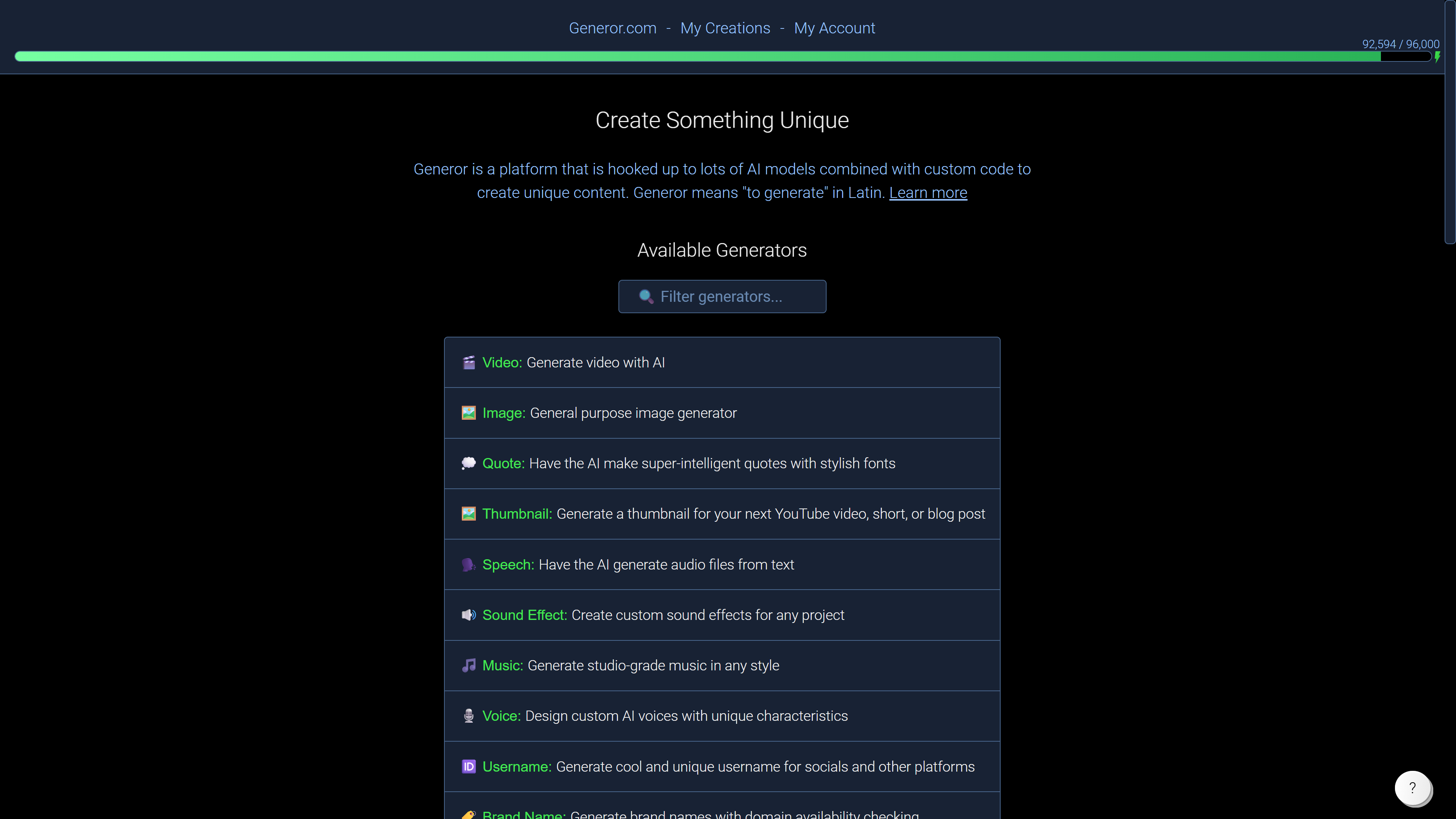
Generor's appeal is variety with a relatively approachable interface. It offers generator types for text, images, and audio, with product-ordering integrations also listed. For a content creator who wants to sample different AI-assisted tasks in one web app, that can be a simpler place to explore than assembling a stack of individual tools. The trade-off is maturity and dependency: some generators are still in development, and the service relies on external APIs. Those details matter if a workflow needs to be repeatable or if a team is building a dependable production process around a particular output. Generor's broad menu makes it a reasonable discovery pick, but buyers should verify that the specific generator they need is ready and behaves consistently.
Best for
Content creators looking for several types of generators in one interface.
Users who want to explore text, image, and audio tasks before choosing specialists.
Buyers who can tolerate a degree of feature maturity variation.
Limitations
Some generators are still in development.
Reliance on external APIs can affect how the overall service behaves.
Confirm the availability and suitability of the exact generator you plan to use.
Shortlist signal: Consider Generor for broad, lightweight exploration, but validate the maturity of the individual generator before building a core workflow around it.
7. GPT Image 2.5

- Developers integrating access to multiple AI models
- Free starter credits
- Starts at Pay-as-you-go credits from $1
- Usage signal: 2.0K
Why it matters
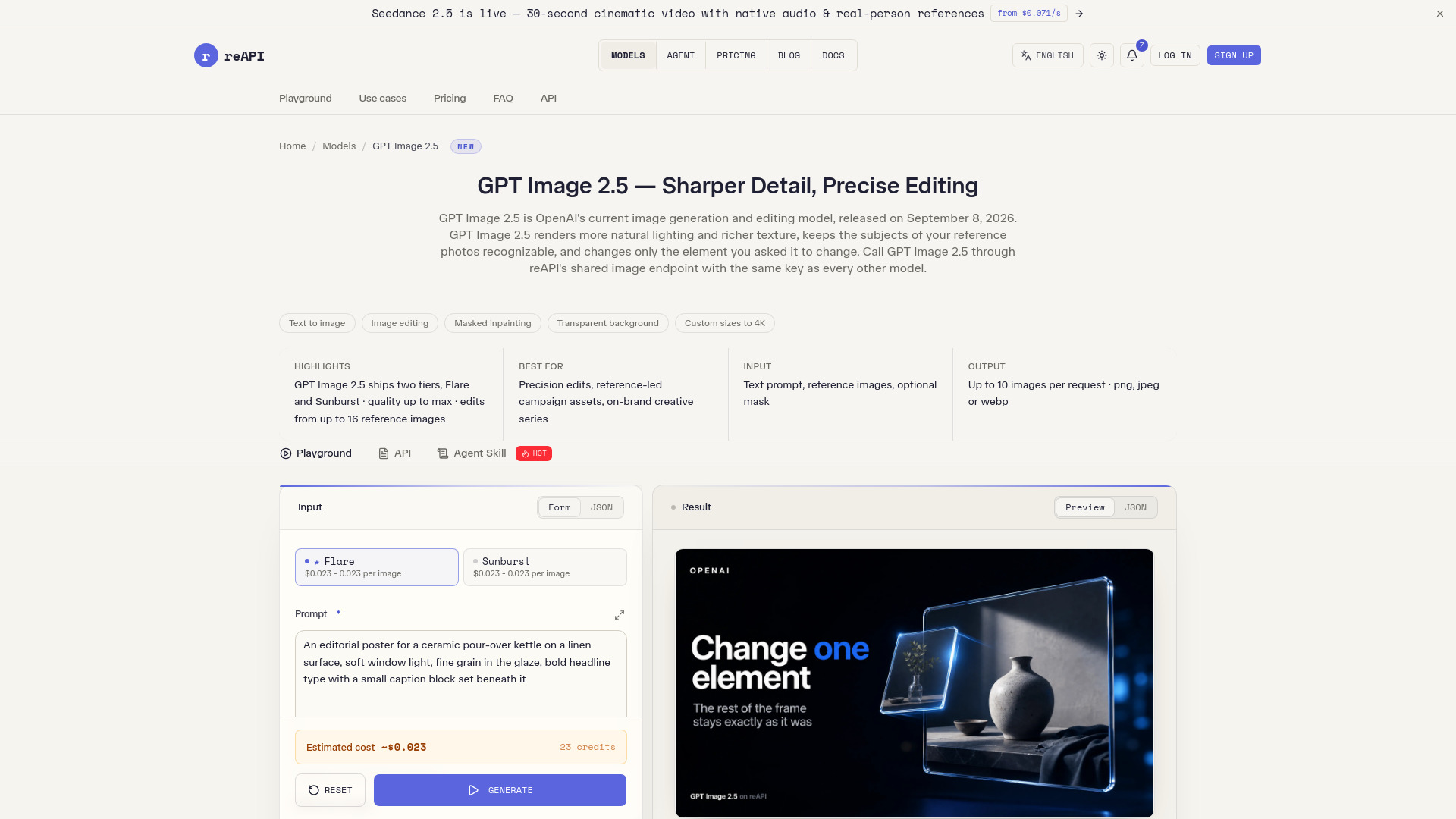
Despite its name, this listing's strongest differentiator is not a standalone image editor: it offers unified API access to more than 100 AI models, with automatic failover based on vendor health, latency, and load. For an application team, consolidating model access and billing can be more useful than another prompt box. The service uses prepaid, pay-as-you-go credits, with no subscription or credit expiration stated, and starter credits give developers a way to begin testing. The engineering trade-off is that paid calls require prepayment and model pricing varies by billing unit. Before routing production traffic through any gateway, check the models you need, estimate usage using their actual billing units, and test whether the failover behavior fits your application's error-handling expectations.
Best for
AI application developers who want one API route to many providers and modalities.
Teams interested in automatic failover to reduce disruption from provider issues.
Projects that prefer prepaid usage over a recurring subscription.
Limitations
Paid API calls require users to prepay credits.
Prices vary by model and billing unit, so costs need a workload-specific estimate.
This is developer infrastructure, not a direct substitute for a hands-on image-editing interface.
Shortlist signal: Shortlist GPT Image 2.5 when you need a unified, pay-as-you-go model API and can manage prepaid credits and model-specific costs.
8. Gpt Image 2.5
- Independent designers making and editing images
- Starts at $10/month
- Usage signal: Not listed
Why it matters
This Gpt Image 2.5 listing focuses on a familiar designer workflow: generate an image from text, then guide an edit with a reference. It also separates a precision-oriented option, GPT Image 2.5 Sunburst, from fast text-to-image generation. That division is useful when a project alternates between quick ideation and more controlled revisions. The product is an independent service and is not officially connected with OpenAI, a distinction buyers should understand before interpreting the name or making assumptions about provider affiliation. Higher-resolution generations use more credits, so a low entry price alone will not tell you how much a real project costs. Test edits at the resolution and level of detail you actually expect to deliver.
Best for
Independent designers who want both text-based image creation and reference-led editing.
Users who need to compare faster generation with a precision-focused editing model.
Small creative projects where a straightforward monthly plan is attractive.
Limitations
The service is independent and is not officially connected with OpenAI.
Higher-resolution generations consume more credits.
Verify the output and credit use for your own image sizes before scaling up.
Shortlist signal: Add Gpt Image 2.5 when you want a focused image-generation and reference-editing interface, and are comfortable checking resolution-based credit use.
9. ModelGenerator

- Game developers creating textured 3D assets
- Starts at Check vendor pricing
- Usage signal: Not listed
Why it matters
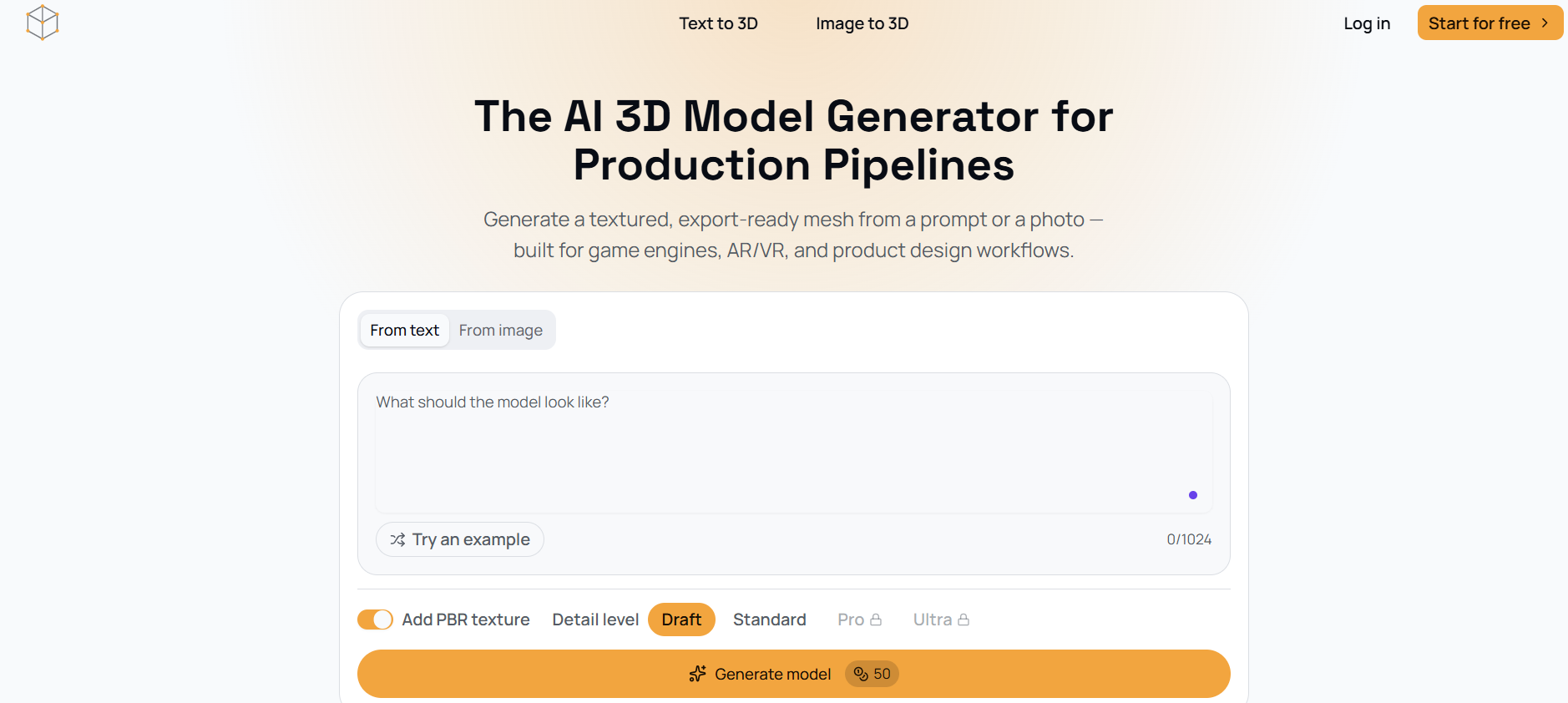
ModelGenerator makes a clear case for a specialist use: create 3D models from text prompts or photos, then export textured meshes as GLB files with PBR materials. Adjustable mesh density adds a practical control for developers thinking about how a generated asset may fit into a game workflow. That is a more concrete production handoff than a flat visual preview, although "export-ready" should not be mistaken for "finished for every pipeline." The service does not provide detailed pricing or package information, and demanding production work may need additional mesh refinement. For a game developer, the real evaluation is whether the generated geometry, materials, and export fit the target project with an acceptable amount of cleanup.
Best for
Game developers prototyping assets from text prompts or reference photos.
Teams that need GLB output with PBR materials for further use.
Creators who want an adjustable mesh-density option during generation.
Limitations
Pricing and package details are not clearly provided; confirm costs with the vendor.
Generated meshes may need refinement for demanding production pipelines.
A 3D-asset workflow is a separate segment from 2D image outpainting.
Shortlist signal: Put ModelGenerator on your shortlist when the target is a textured 3D asset and you can budget time for mesh review and cleanup.
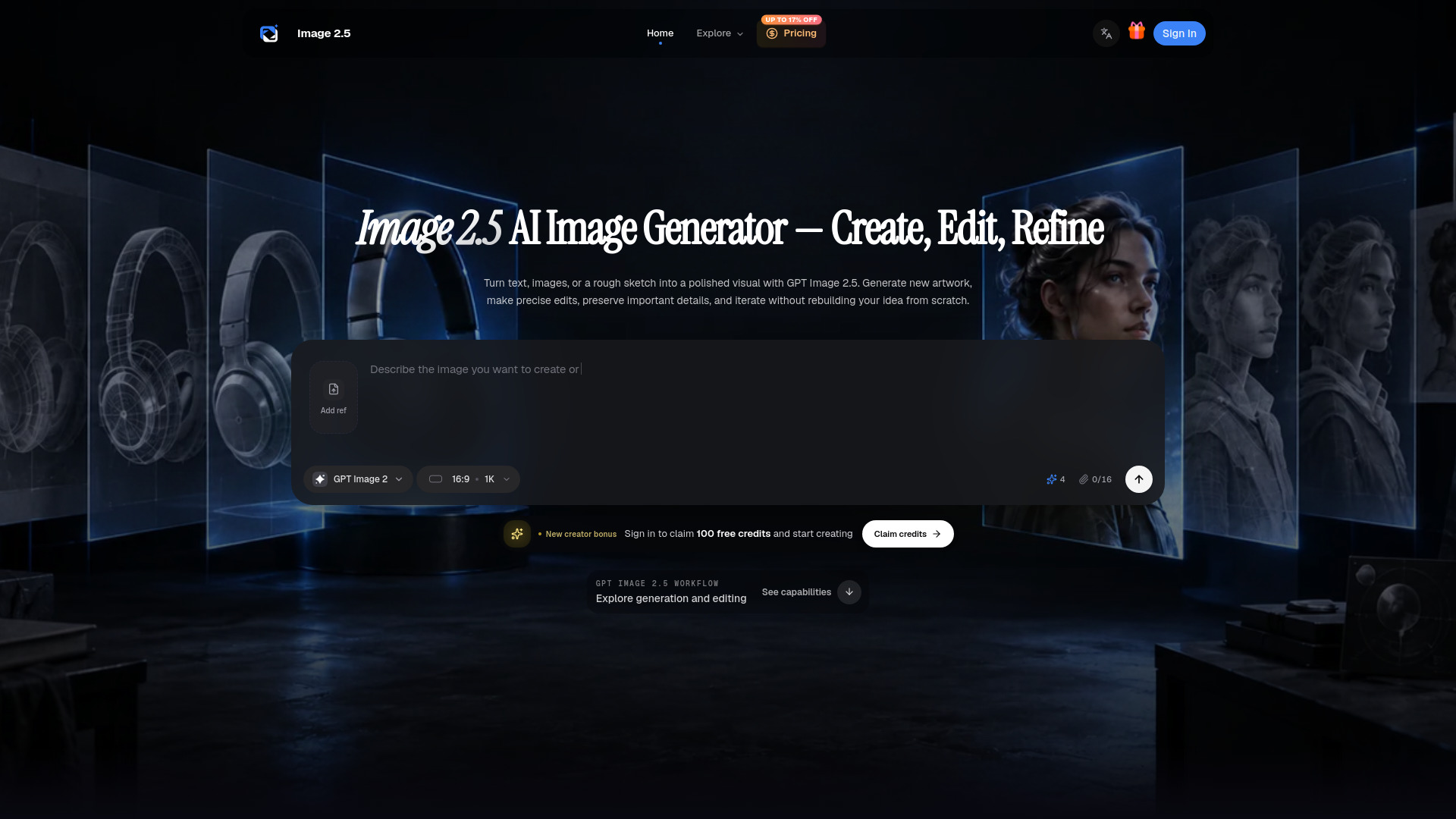
10. Image 2.5

- Graphic designers refining reference-led visuals
- 100 free credits
- Starts at $16.58/month
- Usage signal: Not listed
Why it matters
Image 2.5 is built around both creation and revision: it supports text-to-image generation, reference images, and masks for more precise edits. Custom image sizes up to 4K and multiple quality and export options give designers more room to match a deliverable than a fixed-size generator would. Its stated strength is preserving important product and character details during revisions, which makes it worth testing for visual work where identity or key product features cannot drift. There is still a human-review step: complex prompts can take up to two minutes, and generated text, hands, materials, layouts, or identity details may need correction. Use the free 100 credits to check those failure points on your own assets rather than judging only the first polished result.
Best for
Graphic designers who need both image generation and reference-based editing.
Projects using masks or custom image sizes up to 4K.
Creators who need to review whether important visual details survive revisions.
Limitations
Complex prompts can take up to two minutes to process.
Text, hands, materials, layouts, and identity details still require review.
Generated precision should be tested on real project assets before production use.
Shortlist signal: Choose Image 2.5 when controlled, reference-led image edits matter and you are willing to inspect every final detail.
What to test before choosing
A short, consistent trial will tell you more than a polished sample gallery. Use the same inputs and acceptance criteria across your shortlisted tools so the comparison reflects your work, not differences in the demo material.
Test the actual expansion task. If you mean outpainting, upload an image and ask the vendor or interface to extend the canvas. Check whether it supports the direction and aspect ratio you need; do not treat text-to-image or image-to-image as proof of outpainting.
Keep one reference fixed. For image tools, reuse the same source image and prompt. Note whether the subject, product details, lighting, and style survive each edit.
Measure usable results, not just attractive ones. Record how many generations need a correction, how long the workflow takes, and whether outputs meet your delivery size.
Track credits during a representative run. Credit models differ, and video or high-resolution work can have variable costs. Estimate a month of real use, not one successful test.
Test the handoff. Check export size, file type, collaboration needs, API integration, or GLB materials depending on the product and your pipeline.
Review the failure cases. Try difficult text, hands, layouts, identity details, references, or longer sessions where those are relevant to your work.
Confirm current terms. Free quotas, pricing, model availability, and access requirements can change; verify them with the vendor before committing.
What to do next
Pick two or three tools from the same shortlist path and run a one-hour evaluation with a real asset or brief. For a literal image expansion task, make successful canvas extension a requirement-not a nice-to-have-and remove any candidate that cannot demonstrate it. For broader creative work, compare the quality of the usable output, the time needed to correct it, the friction of collaboration, and the cost of a representative run.
Then check the vendor's current pricing and access terms, especially when a product relies on credits, model-specific rates, or a required account step. A small paid test can be worthwhile when it answers a concrete question about production fit. Avoid buying a year of access based only on a feature list or a single impressive example.
Common mistakes when choosing from a complex top list
Treating every generator as an outpainting tool. Image creation, reference editing, and expanding a canvas are related but distinct tasks. Confirm the precise operation.
Comparing unlike segments by rank alone. An API gateway, a video platform, and a 3D model generator solve different problems. Compare tools within the workflow you need.
Assuming credits have a universal value. Model, resolution, duration, and settings can affect consumption. Estimate with your own usage pattern.
Confusing a free test with a free production plan. Some quotas are small, unspecified, or gated by login or Discord access. Check both the quantity and conditions.
Skipping output review. Generated text, identity details, materials, and geometry can still need human corrections. Plan review time into the workflow.
Overweighting the score or traffic signal. Neither tells you whether a tool can handle your exact source file, output format, or production constraints.
Ignoring service boundaries and dependencies. Confirm vendor affiliation, external API reliance, pricing terms, and how the product handles model access before you build around it.
FAQ
It can refer broadly to using generative AI to extend a creative workflow, or narrowly to outpainting-adding new content beyond an image's original edges. The 10 providers here cover adjacent workflows across image creation and editing, video, 3D, and multi-model platforms. Their descriptions do not establish that every tool offers native outpainting, so verify that capability directly if it is your requirement.