
Finding the right option among the top us ai sales automation companies takes more than comparing feature checklists. The strongest sales workflows often combine prospect research, CRM-connected agents, coaching, content production, and always-on execution. I compared 10 tools across those jobs, then ranked them by practical fit, workflow depth, accessibility, and the strength of their usage signals. The result is a field guide rather than a narrow list of sales engagement platforms: a few entries are direct sales tools, while others are adjacent AI systems that can materially improve how a sales team finds, qualifies, enables, and follows up with buyers.
Start here
The fastest way to use this list is to start with the workflow you need to fix, not the most impressive-sounding AI label.
Choose Sim first for flexible agent building. It is the most credible all-purpose foundation here, with visual, conversational, and code-based development plus more than 1,000 integrations.
Choose SalesTable AI for sales coaching and onboarding. Its AI Sales Coach and AI Sales Manager positioning is much closer to a conventional enablement purchase.
Choose Neura Market when you want to buy or reuse workflows. Its catalog of 27,000-plus workflows is useful for consultants and teams that do not want to build every automation from scratch.
Choose aiOS for founder-led automation. Text-based control through iMessage, WhatsApp, Telegram, phone, and the web makes it unusually accessible.
Choose Muze AI if paid acquisition is part of your revenue engine. It creates and optimizes image and video ads, but it is a marketing execution platform rather than a complete sales stack.
The other five tools are best treated as specialist or unexpected alternatives. They can support research, buyer insight, content, technical execution, and market intelligence, but they should not automatically replace a CRM, sales engagement platform, or human review process.
Segment comparison
| Segment | Strongest fit | What it handles | Watch before buying |
|---|---|---|---|
| Agent builders | Sim, VPS AI | Multi-step workflows, browser tasks, integrations, persistent execution | Governance, limits, and human approval points |
| Sales enablement | SalesTable AI | Coaching, onboarding, rep guidance | Pricing transparency and sales-process fit |
| Workflow marketplace | Neura Market | Reusable automations, prompts, agents, and platform assets | Quality control and seller economics |
| Revenue marketing | Muze AI, Yo MaaS | Ad creation, optimization, audits, buyer strategy | Spend limits, scan costs, and strategic oversight |
| Research and utility | AI Agents Listing, BukiTools, AlphaAI | Research, writing, lightweight productivity, market signals | Narrower scope and less direct sales automation |
This split matters because the phrase AI sales automation can hide several different purchases. A sales leader may want rep coaching; a founder may want an AI employee; an engineer may want a persistent agent runtime. Those are not interchangeable, even when they all promise to reduce manual work.
Shortlist paths
| Your situation | Start with | Why |
|---|---|---|
| You need a configurable sales workflow foundation | Sim | Visual and code-based agents with Salesforce, HubSpot, Gmail, Slack, and other connections |
| You need faster rep ramp-up | SalesTable AI | Focuses on AI sales coaching, onboarding, and guidance |
| You deliver automation for clients | Neura Market | Large library spanning Zapier, n8n, Make, Activepieces, and Pipedream |
| You run a lean founder-led business | aiOS | Lets you control business automation through familiar messaging channels |
| You need demand-generation execution | Muze AI | Produces ad variations and automates optimization across Meta and Google |
For the remaining options, use a narrower test: ask whether the tool improves a measurable stage of the revenue process. If it cannot improve research quality, response time, rep readiness, campaign output, or buyer intelligence, it is probably a useful side tool rather than a core sales automation purchase.
Ranking snapshot
| Rank | Tool | Score | Best for | Starting price |
|---|---|---|---|---|
| #1 | Sim | 92/100 | AI engineers | Free: $0 |
| #2 | Neura Market | 91/100 | Automation consultants | Check vendor pricing |
| #3 | aiOS | 91/100 | Founders | Try: Free |
| #4 | Muze AI | 90/100 | Shopify brands | Free: $0 for 7 days |
| #5 | SalesTable AI | 90/100 | Sales leaders | Check vendor pricing |
| #6 | AI Agents Listing | 88/100 | Researchers | Check vendor pricing |
| #7 | Yo MaaS | 87/100 | Small business owners | Free: $0 |
| #8 | VPS AI | 87/100 | AI agent developers | Spark: $19/month |
| #9 | BukiTools | 87/100 | Content writers | Free: $0 |
| #10 | AlphaAI | 87/100 | Algorithmic traders | Free: $0 |
The scores are not a claim that every tool is a direct competitor. They reflect how useful each product can be within a broader sales-automation stack, balanced against its audience, scope, and purchasing friction.
How we grouped and ranked the list
I grouped the tools by the job they perform in a revenue workflow: build, coach, execute, research, or support. Direct sales relevance received the most weight, but breadth mattered when a product could connect sales activity to adjacent work. Sim ranks first because it combines agent construction with connections to Salesforce, HubSpot, Gmail, Slack, and more than 1,000 integrations. SalesTable AI ranks fifth despite its direct category fit because pricing is hidden behind a sales conversation and its documented focus is narrower.
The ranking also considers the cost of getting started. Free access, a useful trial, or a no-signup workflow lowers the barrier to a meaningful test. Conversely, paid execution limits, ad-spend caps, scan fees, commissions, and usage ceilings count against a tool when they can surprise a small team. Traffic and usage signals provide context, not proof of quality. A busy marketplace may be valuable, but it still needs a quality-control process before you deploy a workflow to customers.
Ranked field notes
1. Sim

- AI engineers
- 1,000 monthly credits; visual and code-based agent building
- Starts at Free: $0
- Usage signal: 135.8K
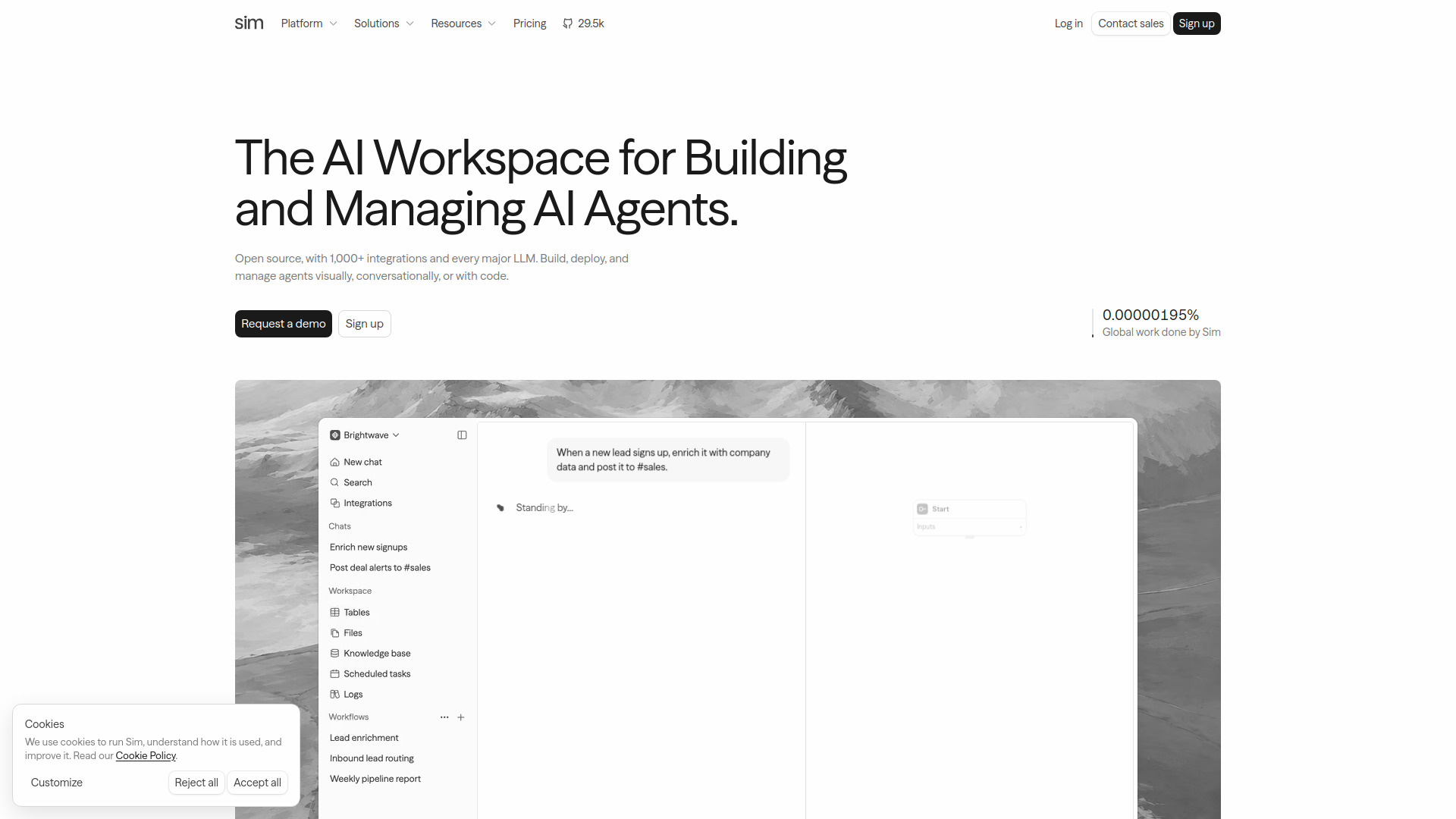
Why it matters Sim is the strongest foundation for teams that want sales automation to behave like an adaptable internal system rather than a fixed sequence of templates. You can build agents visually, conversationally, or with code, then connect them to systems such as Salesforce, HubSpot, Gmail, Slack, Notion, Jira, and Linear. That makes it a sensible place to prototype lead enrichment, routing, follow-up support, or internal sales operations without committing to one narrow interaction model. The free plan is generous enough for exploration, though the one-workspace, five-table, 5 GB storage, and 30-day log-retention limits will matter once usage grows.
Best for
AI engineers building custom revenue workflows
Teams that need broad integration coverage
Technical operators who want visual and code-based control
Limitations
Advanced capabilities and higher execution limits require paid plans
Free usage is constrained to one workspace, five tables, 5 GB of storage, and 30-day logs
It may be more technical than a sales-only team wants
Shortlist signal: Add Sim when you want one configurable agent layer connecting CRM, communication, and sales operations.
2. Neura Market

- Automation consultants
- 27,000+ workflows and 100,000+ AI resources
- Starts at Check vendor pricing
- Usage signal: 118.0K
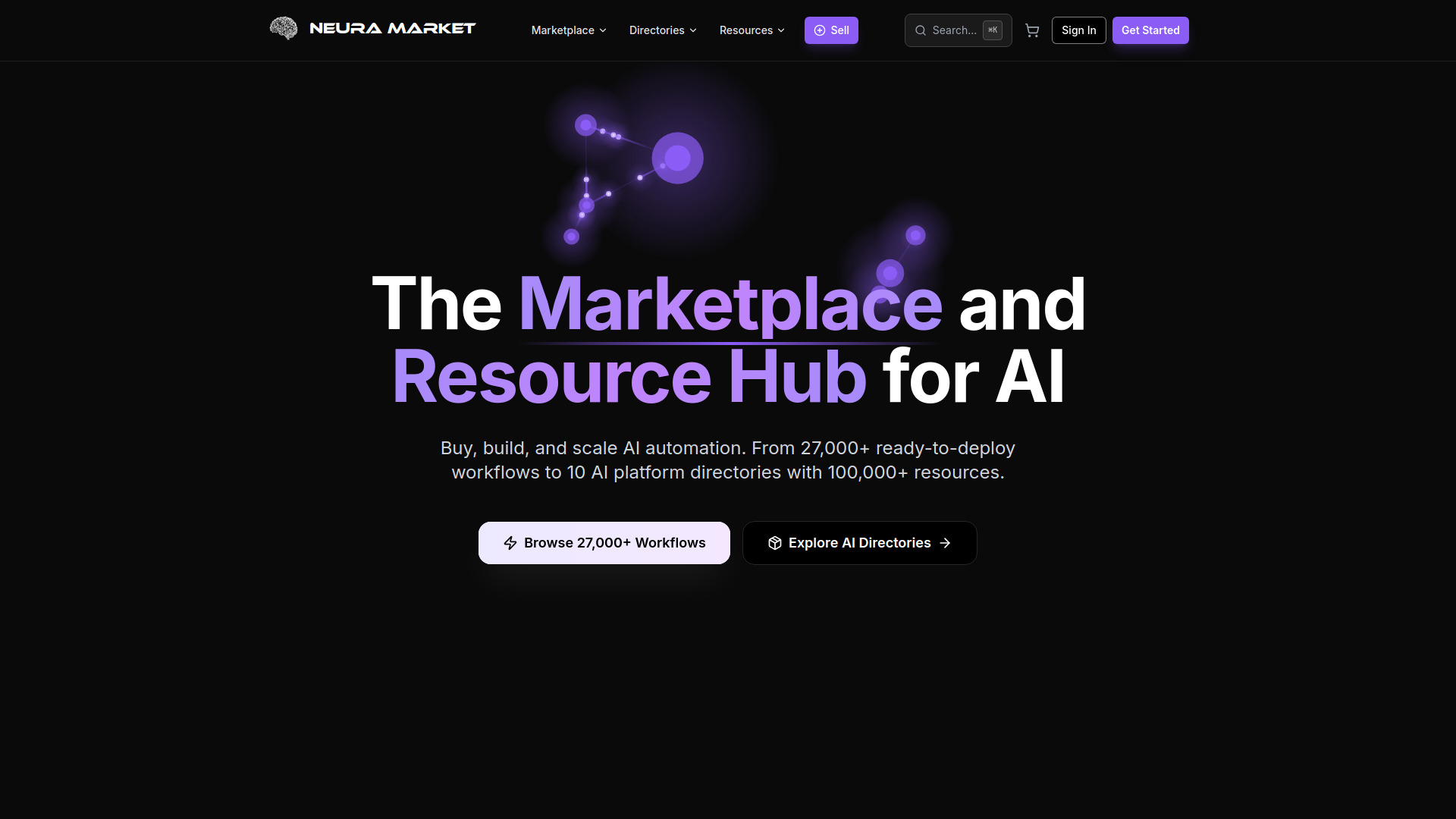
Why it matters Neura Market takes a different route: instead of asking a team to design every sales automation from a blank canvas, it offers a very large catalog of ready-to-deploy workflows, prompts, tools, rules, agents, and integrations. The support for Zapier, n8n, Make, Activepieces, and Pipedream is particularly useful for consultants who work across client stacks. Its sales and operations bundles can shorten discovery and prototyping, but the marketplace model means you still need to inspect each asset, understand its dependencies, and test it with realistic data. Think of it as an acceleration layer for automation work, not a turnkey sales methodology.
Best for
Automation consultants serving multiple clients
Teams comparing workflow patterns before building
Operators who already use Zapier, n8n, Make, or Pipedream
Limitations
Sellers pay commission on every sale
Lower commission tiers require sustained sales thresholds
Marketplace assets still require review, maintenance, and security checks
Shortlist signal: Add Neura Market when reusable workflow assets matter more than a single all-in-one sales platform.
3. aiOS

- Founders
- 5 lifetime messages per device; no signup required
- Starts at Try: Free
- Usage signal: 31.7K

Why it matters The appeal of aiOS is operational simplicity. Rather than forcing a founder to open another dashboard for every task, it presents an AI employee that can be controlled through iMessage, the web, WhatsApp, Telegram, and phone. That interaction model could make lightweight sales administration easier: drafting follow-ups, organizing requests, or moving a business task forward from a familiar channel. It also covers content generation for carousels, posts, images, video, and websites. The catch is pricing complexity and usage limits. A five-message lifetime trial is enough to understand the interaction, but not enough to validate a serious sales process.
Best for
Founders managing sales and operations personally
Small businesses that prefer text-based control
Teams seeking one subscription for several AI tasks
Limitations
Pricing tiers and usage limits can be complex
Advanced capabilities require higher-priced plans
A broad AI operating system may lack the depth of a dedicated sales platform
Shortlist signal: Add aiOS when reducing tool switching is more important than building a deeply specialized sales workflow.
4. Muze AI

- Shopify brands
- 7-day free trial with AI ad creation and optimization
- Starts at Free: $0 for 7 days
- Usage signal: 7.8K
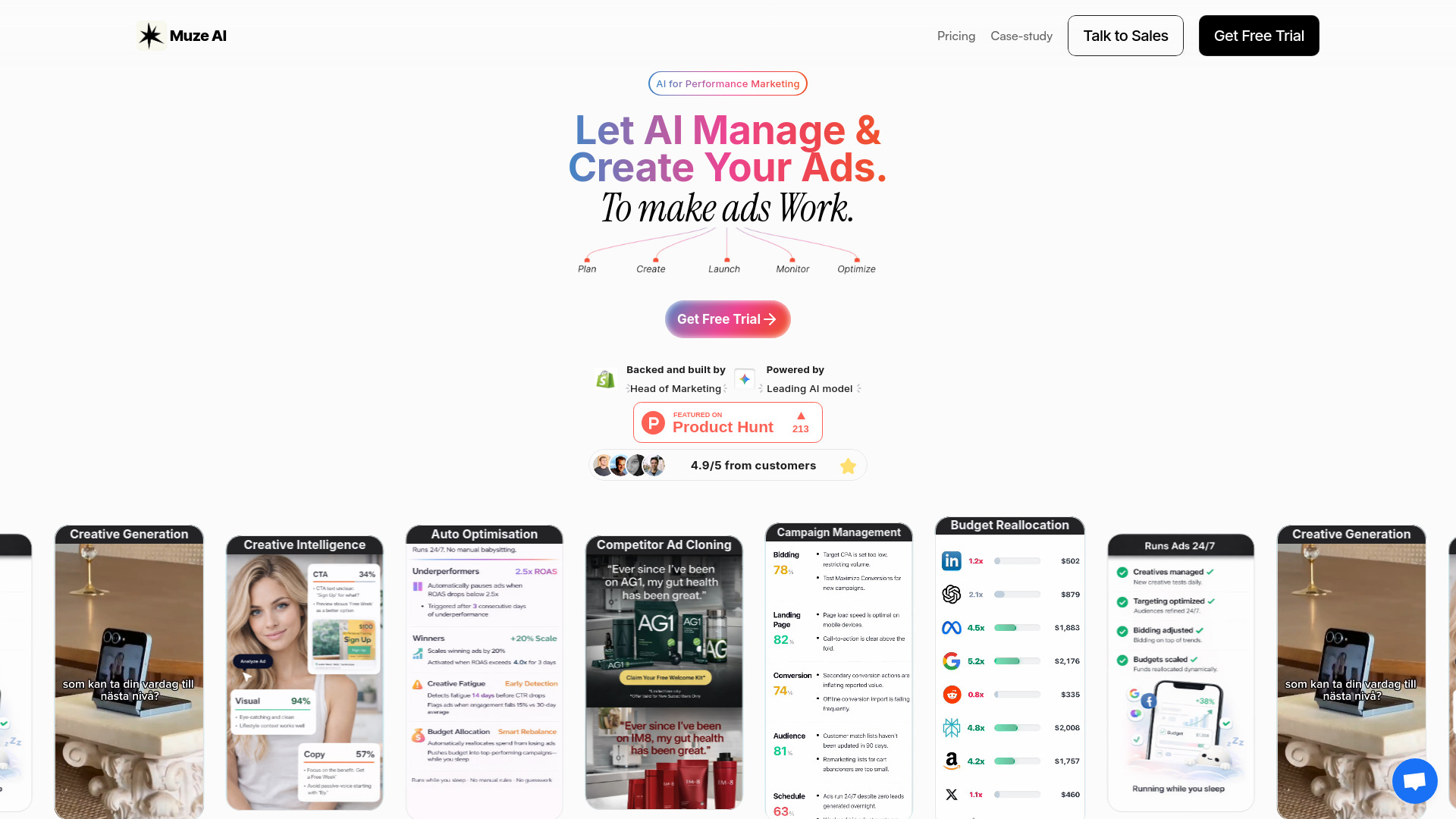
Why it matters Muze AI belongs on this list because many sales teams are really trying to automate the handoff between demand generation and revenue. Its Ads on Autopilot approach creates image and video ads, generates 10 variations in 90 seconds, and handles automated optimization and budget reallocation across Meta and Google. That can be valuable for a Shopify brand that needs more creative volume without hiring a full performance marketing team. It is not a substitute for prospecting, CRM management, or rep coaching. It is an adjacent growth engine, and its autonomous decisions deserve close monitoring before you let them control meaningful spend.
Best for
Shopify brands running Meta and Google campaigns
Lean teams that need frequent ad variations
Businesses testing automated budget reallocation
Limitations
The platform becomes responsible for critical performance marketing decisions
The Power plan supports up to $10,000 in monthly ad spend
Power starts at $399 per month, which may be too much for early testing
Shortlist signal: Add Muze AI when acquiring demand is the bottleneck and your team can supervise automated ad execution.
5. SalesTable AI

- Sales leaders
- Free plan available
- Starts at Check vendor pricing
- Usage signal: 122

Why it matters SalesTable AI is the most direct sales-enablement entry in the ranking. Its AI Sales Coach and AI Sales Manager concepts point toward a practical problem: helping reps get answers, learn the playbook, and improve without waiting for a manager's calendar to open. The platform also focuses on sales onboarding and coaching, with a stated ability to reduce rep ramp-up time by up to 50%. That makes it more relevant to a growing sales organization than a general-purpose agent builder. Still, the buying process requires care. Pricing is not transparent, and there is no clearly stated direct-access free trial, so sales leaders should request a workflow demonstration using their own enablement materials.
Best for
Sales leaders building repeatable onboarding
Teams that need always-available coaching
Organizations trying to shorten rep ramp-up
Limitations
Pricing requires contacting sales
No explicit free tier or direct-access trial is stated
It is less suitable for teams seeking broad workflow automation
Shortlist signal: Add SalesTable AI when rep readiness and coaching are the measurable sales bottlenecks.
6. AI Agents Listing

- Researchers
- Free plan available
- Starts at Check vendor pricing
- Usage signal: Not listed
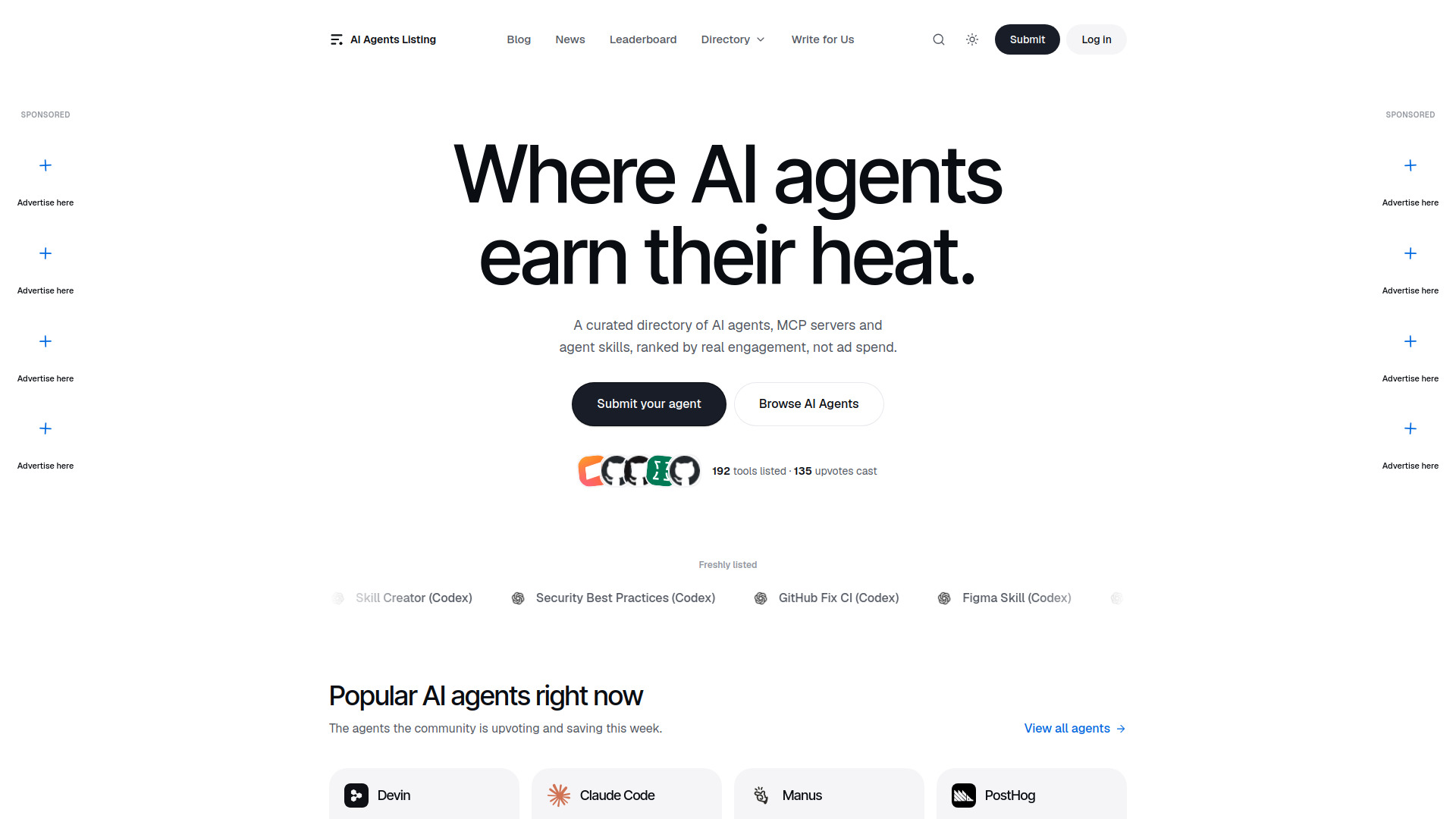
Why it matters AI Agents Listing is an unexpected alternative for teams that rely on research before a sales conversation. Its underlying positioning centers on autonomous task execution, web browsing, research, and multi-step planning. That can support account research, market scans, or first-pass briefing documents, where the cost of manually collecting information often delays outreach. It should not be mistaken for a complete sales automation system. Autonomous research still needs a review step, especially when the output may influence qualification or personalization. The service is identified as paid, but package prices are not clearly presented, so the first test should focus on output quality and repeatability rather than assuming a low-cost entry point.
Best for
Researchers preparing account or market briefs
Teams with repetitive multi-step web tasks
Operators who want autonomous browsing assistance
Limitations
Pricing details are not presented as a clear package structure
Autonomous outputs still require user review
It does not document CRM or sales-engagement depth
Shortlist signal: Add AI Agents Listing when research is slowing prospect preparation and a human can verify every result.
7. Yo MaaS (Marketing-as-a-Service)

- Small business owners
- 7-day Essential trial with AI website grading
- Starts at Free: $0
- Usage signal: Not listed
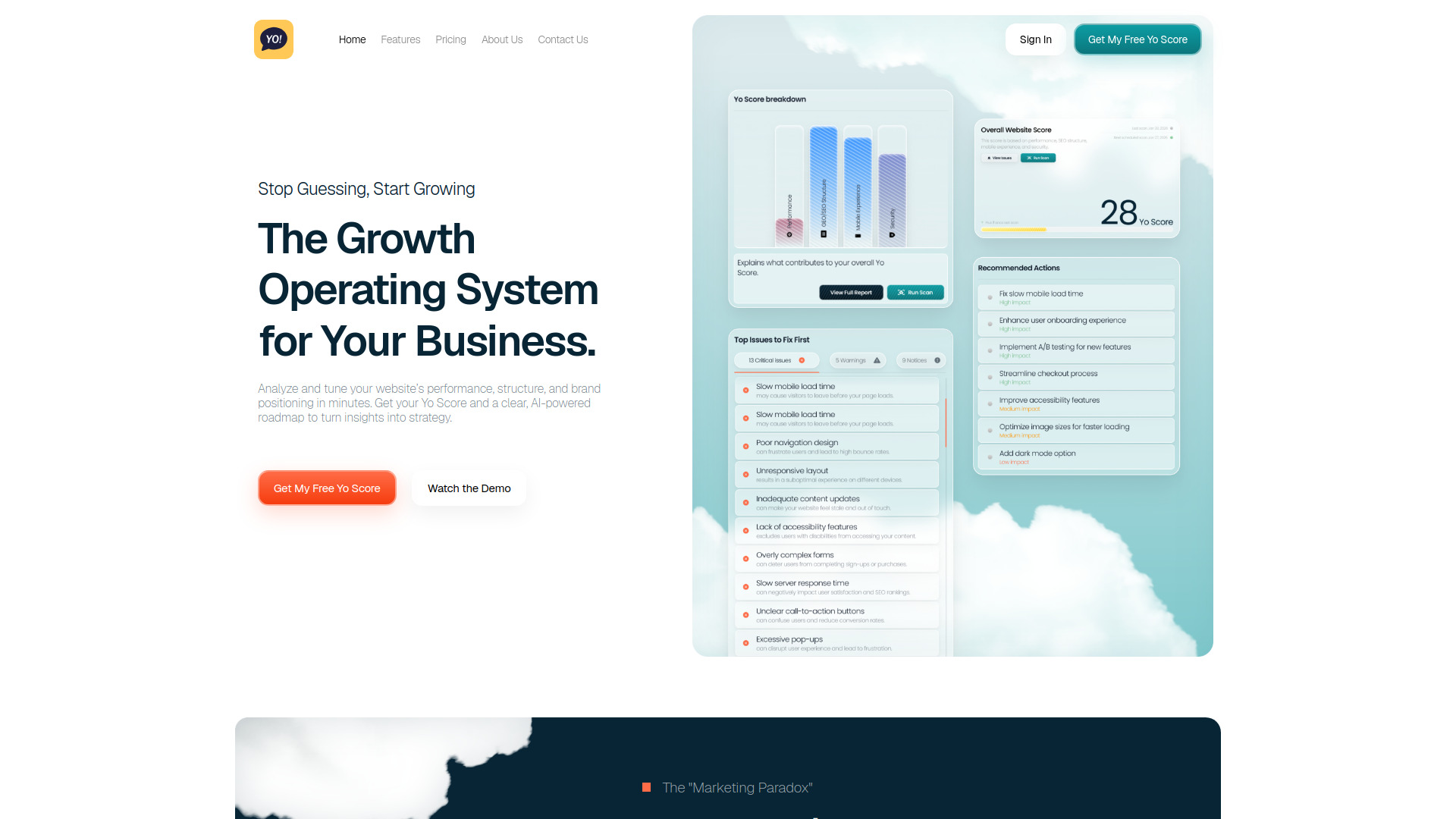
Why it matters Yo MaaS is useful before automation begins, when a business still needs to understand why its website and positioning are failing to create demand. It combines automated technical and SEO audits through the Yo Score with generative engine optimization, buyer personas, brand insights, competitor analysis, and a prioritized growth roadmap. For a small business owner, that combination can turn vague marketing concerns into a sequence of actions that sales and marketing can share. The economics need scrutiny: full website deep-dive scans cost $49.95 per scan on every plan, while the free plan only shows the top three issues and scans the homepage weekly.
Best for
Small businesses diagnosing website conversion problems
Owners who need buyer-persona and competitor guidance
Teams connecting SEO work to sales priorities
Limitations
Full deep-dive scans cost $49.95 per scan
The free plan shows only the top three issues
It is a strategy and diagnostics tool, not a sales engagement platform
Shortlist signal: Add Yo MaaS when weak positioning or website performance comes before outbound automation.
8. VPS AI

- AI agent developers
- Free plan available
- Starts at Spark: $19/month
- Usage signal: Not listed
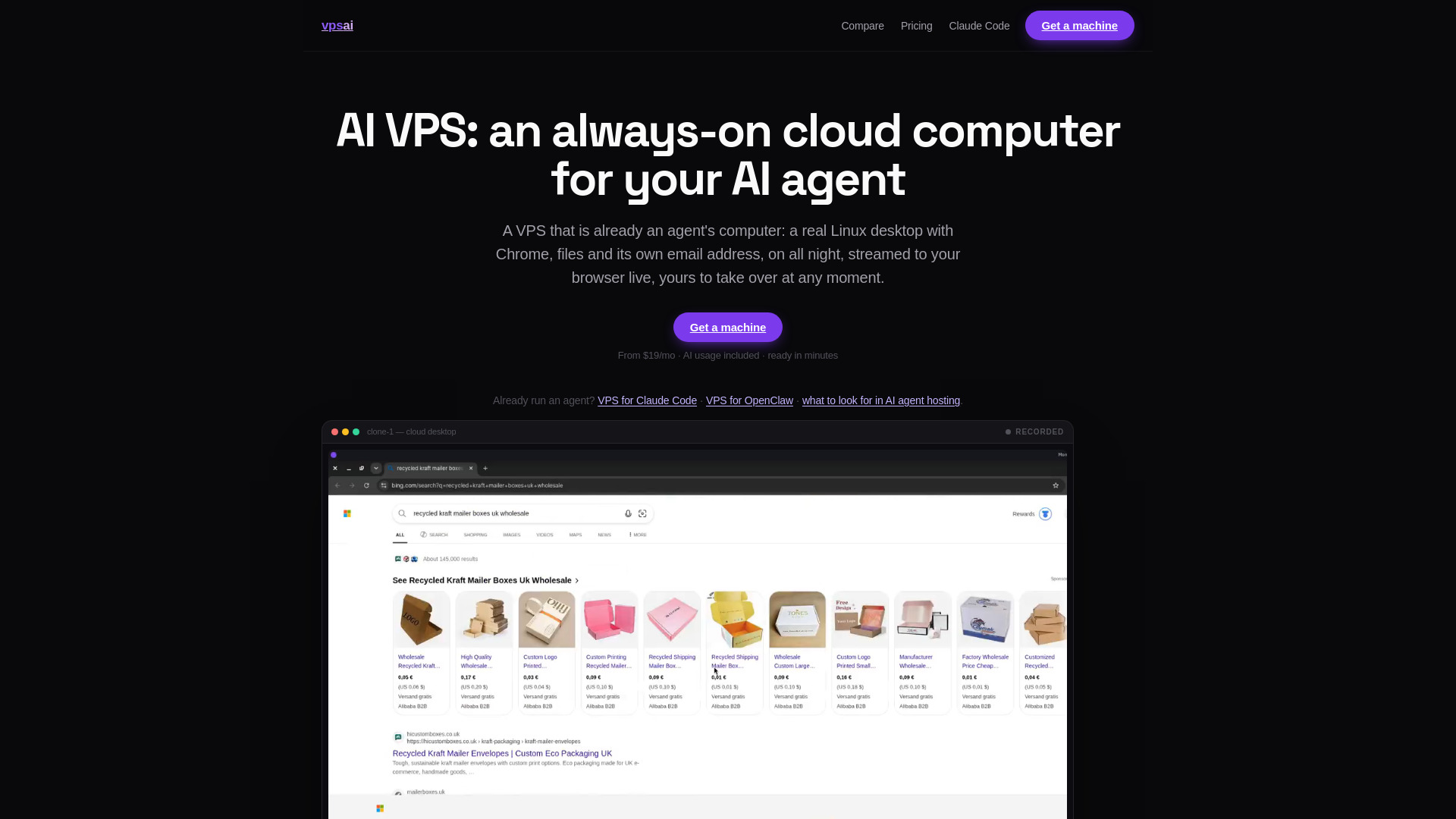
Why it matters VPS AI addresses a practical infrastructure problem: an agent cannot complete long-running work if it depends on a laptop that goes to sleep. It provides an always-on cloud computer with a persistent Linux desktop, Chrome, files, terminal, browser logins, and live screen streaming. For technical sales operations, that could support browser-based research, persistent sessions, or controlled agent tasks that need to continue after business hours. The graphical desktop is a meaningful distinction from a command-line-only server. However, this is infrastructure, not sales software. A paid plan is required for chat and tasks, plans start at $19 per month, and additional top-ups may apply.
Best for
Developers running browser-based AI agents
Teams that need persistent logins and environments
Operators who want live remote takeover of agent work
Limitations
Chat and tasks require a paid plan
Additional top-ups may sit outside the $19 starting price
It requires technical ownership and does not provide sales-specific workflows
Shortlist signal: Add VPS AI when agent continuity and browser access matter more than native sales features.
9. BukiTools
- Content writers
- Free forever; no signup or credit card required
- Starts at Free: $0
- Usage signal: Not listed
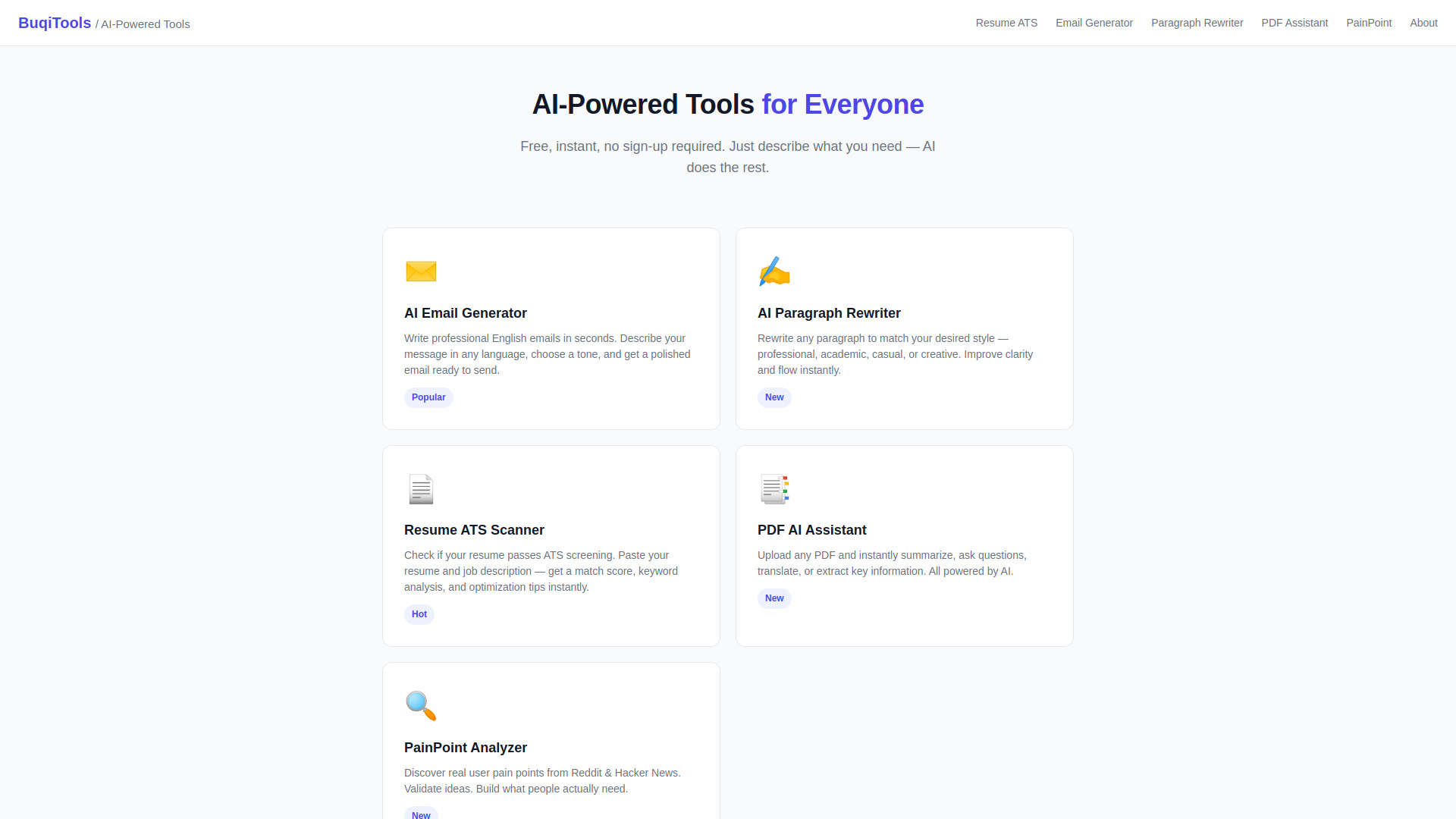
Why it matters BukiTools is a lightweight utility suite, but that can be exactly what a small sales team needs for quick communication tasks. It offers five AI tools, including professional email generation, paragraph rewriting, a PDF AI assistant, a resume ATS optimizer, and a pain-point analyzer. No registration is required, and the site emphasizes that it does not store data. That makes it easy to test for one-off email polishing or basic document work without starting a procurement process. The trade-off is obvious: there are no documented tiers or advanced plans, and the product is limited to the tools on the site. It complements a sales stack rather than automating it.
Best for
Content writers and sales reps polishing messages
Small teams needing quick no-signup utilities
Users who prefer a privacy-first lightweight tool
Limitations
Scope is limited to the five listed tools
No pricing tiers or advanced plans are provided
It does not replace CRM, sequencing, coaching, or agent orchestration
Shortlist signal: Add BukiTools when you need free, low-friction writing support rather than end-to-end automation.
10. AlphaAI

- Algorithmic traders
- 20 requests/minute and 100/day; REST and MCP access
- Starts at Free: $0
- Usage signal: Not listed
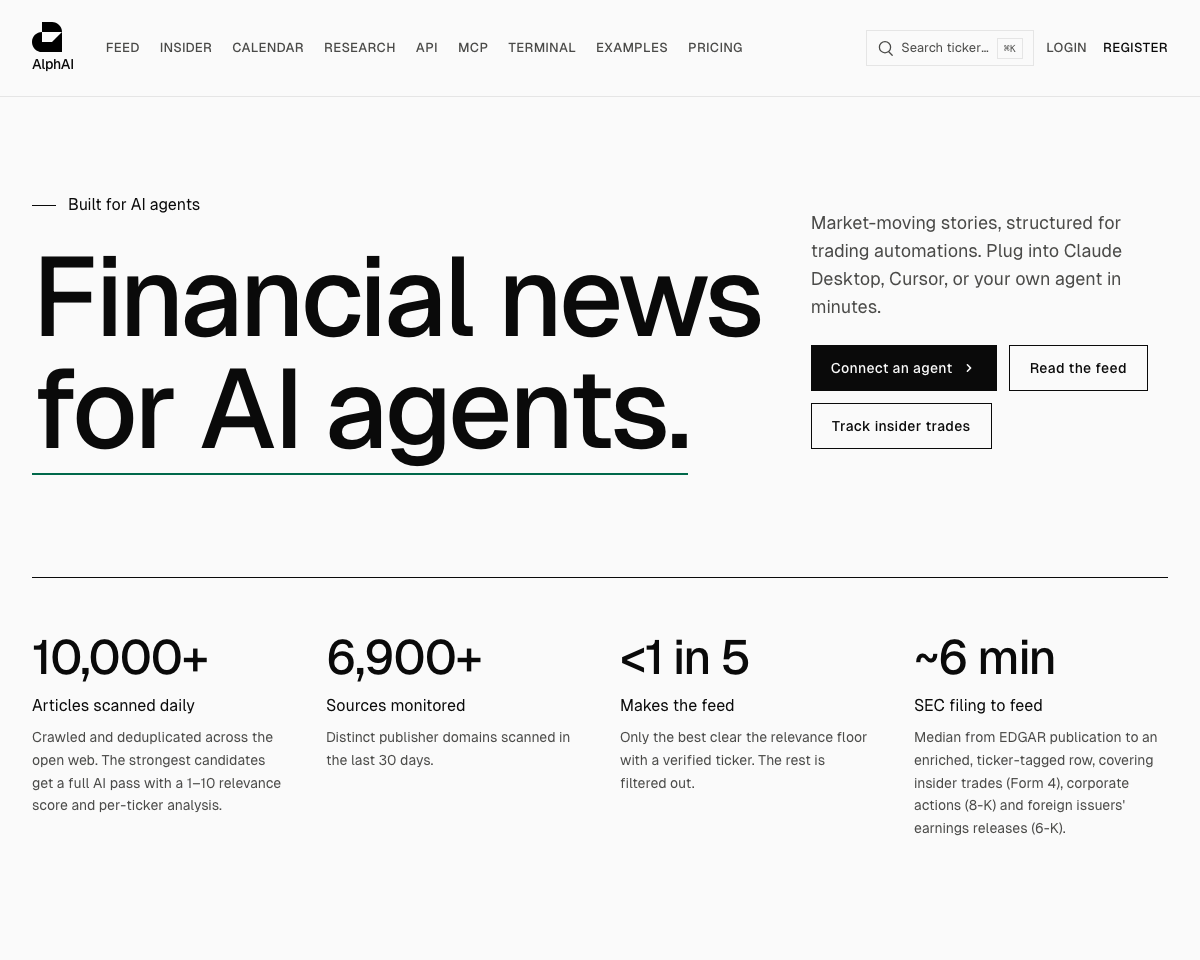
Why it matters AlphaAI is the most specialized adjacent option in the ranking. It provides structured financial news with relevance scores from 1 to 10, per-ticker impact analysis, written sentiment reasoning, and SEC events such as Form 4 insider trades, 8-K corporate events, and 6-K earnings releases. That is useful for sales or research teams selling into financial services, investing, or market-sensitive industries where timely context improves account conversations. It is not a general prospecting or sales automation product. The free plan is capped at 20 API requests per minute and 100 per day, and free API and MCP access covers a 30-day archive.
Best for
Algorithmic traders and financial researchers
Teams selling into market-sensitive accounts
Developers consuming structured news through REST or MCP
Limitations
Free request limits may constrain production use
Free API and MCP access is limited to a 30-day archive
Its financial focus makes it a poor fit for general sales teams
Shortlist signal: Add AlphaAI only when structured financial intelligence directly improves your account or market workflow.
What to test before choosing
Run the same small workflow through two or three finalists instead of judging a polished demo. For a sales automation evaluation, test:
- 1
Input quality: Can the tool handle the messy CRM notes, emails, PDFs, or web pages your team actually uses?
- 2
Action control: Does it recommend an action, draft one, or execute one? Confirm where approvals are required.
- 3
Integration depth: Check whether the connection can read and write the fields your process depends on, not just display a logo in an integration directory.
- 4
Repeatability: Run the same task several times. An impressive one-off answer is not a reliable workflow.
- 5
Cost under real volume: Include credits, scans, commissions, ad spend, top-ups, storage, retention, and premium execution limits.
- 6
Human handoff: Make sure a rep can inspect, correct, and override an AI output before it reaches a prospect.
For Sim or VPS AI, test persistence and failure recovery. For SalesTable AI, bring real onboarding material. For Muze AI, use a limited campaign budget. For Neura Market, inspect the workflow dependencies and permissions before connecting production systems.
What to do next
Pick one revenue bottleneck and define a measurable baseline. That might be time to prepare an account brief, days to onboard a new rep, hours spent creating ad variations, or the percentage of follow-ups completed on time. Then choose the narrowest tool that can improve that metric without creating a new review burden.
A sensible sequence is to prototype with Sim if you need flexibility, SalesTable AI if enablement is the issue, or aiOS if a founder needs a simpler control surface. Use Neura Market to accelerate implementation when your team already knows which automation platform it prefers. Treat the remaining tools as supporting specialists, and keep the first deployment small enough that a human can audit every output.
Common mistakes when choosing from a complex top list
Treating every AI tool as a sales platform. Agent infrastructure, ad optimization, research, and sales coaching solve different problems.
Confusing integrations with completed workflows. A Salesforce connection does not prove that lead routing, enrichment, or follow-up works for your process.
Ignoring operational limits. Free credits, request caps, storage limits, scan fees, commissions, and ad-spend ceilings can change the economics quickly.
Automating before fixing the input. Poor positioning, incomplete CRM data, or unclear qualification rules will produce faster poor decisions.
Skipping human approval. Prospect-facing messages, account classifications, and budget changes deserve review until the system has earned trust.
Using traffic as the whole ranking. Usage signals help establish market context, but audience fit and workflow performance matter more for your purchase.
FAQ
Sim is the best starting point for teams that want a configurable foundation. It supports visual, conversational, and code-based agent development and connects to more than 1,000 integrations, including Salesforce, HubSpot, Gmail, and Slack. Sales teams that want coaching rather than orchestration should start with SalesTable AI instead.